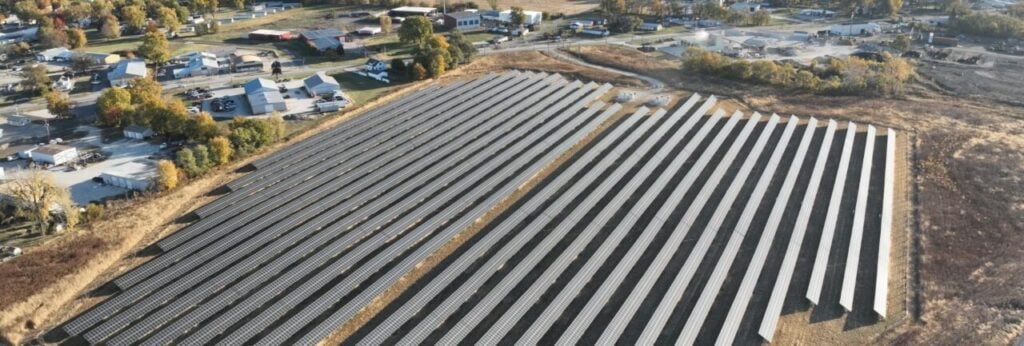
This week, several companies in the US community solar sector made announcements, including ENGIE and Ampion’s addition of new solar capacity in Illinois, Reactivate’s plans to build new solar projects on former landfill sites and the completion of the first phase of construction at a Pivot Energy portfolio developed in tandem with fashion company Tapestry.
ENGIE and Ampion add 5.5MW in Illinois
On Tuesday, ENGIE North America and US community solar installer Ampion announced the start of commercial operations at the Knox 2A and Knox 2B projects in Galesburg, Illinois. Electricity generated at the facilities will be made available to the state’s electricity grid, and local residents and businesses will subscribe to the projects through Ampion, and receive credits on their monthly electricity bills in return.
Try Premium for just $1
- Full premium access for the first month at only $1
- Converts to an annual rate after 30 days unless cancelled
- Cancel anytime during the trial period
Premium Benefits
- Expert industry analysis and interviews
- Digital access to PV Tech Power journal
- Exclusive event discounts
Or get the full Premium subscription right away
Or continue reading this article for free
An ENGIE spokesperson confirmed to PV Tech that the projects each have a capacity of 2.8MW, giving the portfolio a total capacity of 5.6MW. The companies expect 443 households and businesses to subscribe to the portfolio, and expect residential customers to receive 20% savings on the value of solar bill credits applied to their electricity bills.
The companies also specified that more than 60% of the subscriptions are reserved for “low-to-moderate income households”, and those that are enrolled in existing state programmes, such as Medicaid. As part of our year-in-review coverage, Ampion’s senior executive director of enterprise acquisition, Vihann Kong, told PV Tech that working with existing legal frameworks and state policies had helped the company navigate “significant uncertainty” in 2025, and the developer looks to be continuing this approach into 2026.
“Ampion is proud to work with ENGIE to help low-to-moderate income families in Illinois access the cost-saving benefits of community solar,” said Ampion CEO and founder Nate Owen. “With the majority of the benefits reserved for households enrolled in programs like LIHEAP, Medicaid and SNAP, these solar farms will deliver much-needed electricity savings.”
Reactivate to build renewable energy projects on landfill sites
On Wednesday, US renewable energy developer Reactivate, a subsidiary of Invenergy, announced plans to collaborate with US waste management firm WM on converting more than 50 former landfill sites into new renewable energy projects.
The companies noted that the new projects would consist of community solar, “small” utility-scale solar and battery energy storage systems, and Reactivate confirmed to PV Tech that the community solar projects would be sized at 3-5MW, while the utility-scale facilities would have a capacity of 5-20MW. The company also specified that the portfolio would cover 21 states.
Reactivate also noted that it would develop, build and own and operate the projects itself, and is aiming to start commercial operations at the “first phase” of projects by late 2027.
“Repurposing sites that would otherwise be vacant former landfills and cannot support traditional development helps us meet America’s growing energy demand,” said Utopia Hill, Reactivate CEO.
The project follows the construction of a number of new solar projects at brownfield sites in the US, including Syncarpha’s development of a solar-plus-storage project at a former chemical manufacturing site in Massachusetts, and BrightNight’s building of a solar project at a former coal mine in Kentucky.
Pivot Energy to supply RECs to fashion company Tapestry
Earlier today, US independent power producer (IPP) Pivot Energy announced the completion of three community solar projects in Illinois, with a combined capacity of 13.5MW.
The projects—in Dover, Ottawa and Peoria—are the first of a five-project collaboration with US luxury fashion company Tapestry that will see the latter acquire renewable energy credits (RECs) from the projects for 15 years. Pivot expects to complete construction at the remaining projects by 2030, and the arrangement builds on Tapestry’s investment in the renewable energy space, which saw the company reach 100% renewable electricity across its stores and fulfilment centres around the world.
“These Illinois solar projects mark a significant milestone in Tapestry’s renewable energy strategy,” said Tapestry global head of ESG and sustainability Logan Duran. “Our partnership with Pivot Energy has been instrumental in achieving 100% renewable electricity across our own operations, a key step toward meeting our science-based climate targets.”
The news follows Pivot’s raising of US$225 million to support the development of community solar projects and the acquisition of US-made solar panels, announced last month. While the company did not specify if these funds have been used in the Tapestry agreement, the financing follows both a debt warehouse facility and a module supply deal signed earlier last year.