Australia’s federal government has released a consultation paper detailing information on the proposed Solar Sharer Offer (SSO).
The SSO is a proposed regulated retail tariff mechanism intended to improve utilisation of excess daytime solar generation and broaden access to low-cost electricity for households without rooftop PV systems.
Try Premium for just $1
- Full premium access for the first month at only $1
- Converts to an annual rate after 30 days unless cancelled
- Cancel anytime during the trial period
Premium Benefits
- Expert industry analysis and interviews
- Digital access to PV Tech Power journal
- Exclusive event discounts
Or get the full Premium subscription right away
Or continue reading this article for free
The initiative would be implemented via the Default Market Offer (DMO) framework, requiring retailers in regulated jurisdictions to make an SSO tariff available from 2026-27.
The Solar Sharer programme is designed to respond to structural shifts in Australia’s electricity supply and demand profile driven by rapid growth in distributed PV.
The consultation paper notes that midday solar output increasingly suppresses wholesale prices and drives minimum operational demand levels, creating challenges for system operation, network utilisation and retailer hedging.
Under the proposed model, first revealed earlier this year, participating households would receive a defined period of zero-cost electricity each day during periods of high solar availability, with retailers recovering costs through adjusted tariffs outside the free-use window. This would be for at least three hours a day.
Although the consultation paper does not prescribe a fixed time window, the government signals that the zero-price interval would align with periods of high rooftop PV output, typically between late morning and early afternoon.
Participation would require smart metering and be voluntary, with retailers obliged to offer the tariff alongside existing DMO-compliant products. The Australian Energy Regulator (AER) would integrate the Solar Sharer Offer into future DMO determinations, including cost-stack modeling, tariff structure requirements and consumer protections.
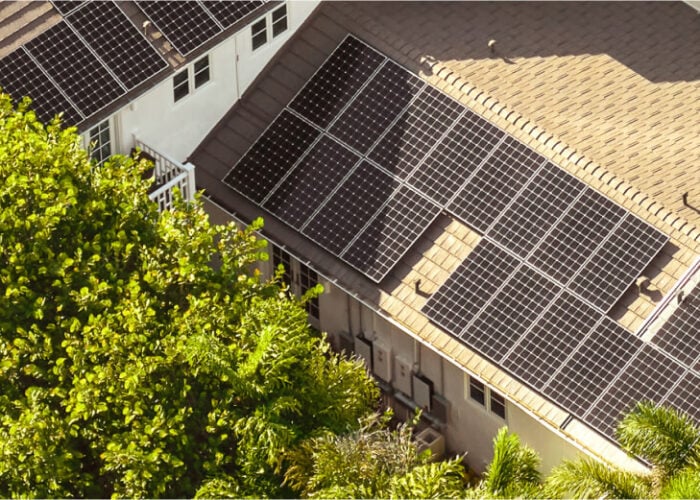
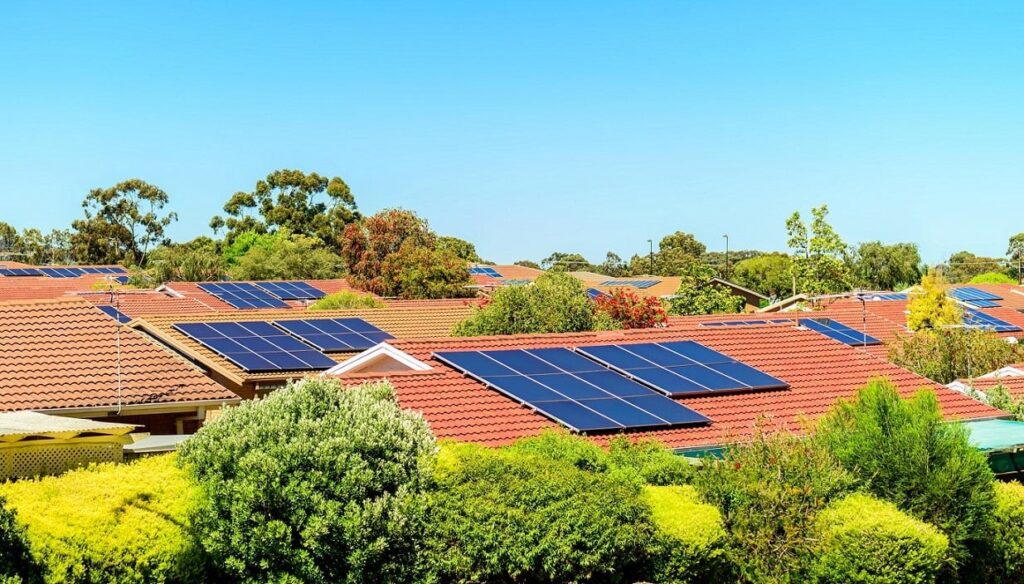
Australia’s rooftop PV deployment provides the underlying rationale for the Solar Sharer mechanism. As reported by PV Tech, cumulative rooftop PV capacity reached 26.8GW in H1 2025, with residential and commercial installations continuing to expand despite falling feed-in tariffs and increasing network constraints:
The operational consequences of this distributed generation growth have already been observed in the National Electricity Market (NEM).
Earlier this year, minimum operational demand reached record lows as rooftop solar generation peaked at approximately 15GW, showcasing the increasing penetration of inverter-based generation in the daytime supply mix and the resulting need for enhanced demand-side flexibility and system services.
From a system perspective, the Solar Sharer Offer is positioned as a demand response instrument rather than a generation subsidy.
The consultation paper highlights objectives including improving utilisation of existing network infrastructure, reducing the frequency of negative wholesale prices, mitigating curtailment risk for distributed PV and large-scale solar assets, and lowering wholesale hedging costs for retailers.
The policy also seeks to address distributional equity concerns, recognising that households without rooftop PV currently do not benefit directly from zero-marginal-cost solar generation despite contributing to network and system costs.
The consultation paper acknowledges potential risks associated with implementing a zero-price retail window.
These include cross-subsidisation between tariff cohorts, potential rebound peaks immediately after the free period, and consumer comprehension challenges associated with more complex time-varying tariffs.
It also notes interactions with feed-in tariffs, demand tariffs and network pricing structures, which will require coordination between the AER, distribution network service providers and retailers.
For solar industry stakeholders, the Solar Sharer programme could influence rooftop PV and behind-the-meter (BTM) battery economics. Increased daytime consumption could partially mitigate declining feed-in tariffs by improving self-consumption value for existing PV owners, while also reducing the arbitrage value proposition for residential batteries if midday prices are structurally suppressed.
Conversely, more predictable demand shaping could improve system conditions for utility-scale solar and storage assets by reducing midday oversupply and shifting consumption toward periods of high renewable output.
The government has indicated that consultation feedback will inform the 2026–27 DMO determination, with the Solar Sharer Offer targeted for implementation from 1 July 2026 in New South Wales, South Australia and south-east Queensland, with potential extension to additional jurisdictions subject to regulatory alignment
The Energy Storage Summit Australia 2026 will be returning to Sydney on 18-19 March. It features keynote speeches and panel discussions on topics such as the Capacity Investment Scheme, long-duration energy storage, and BESS revenue streams. PV Tech Premium subscribers receive an exclusive discount on ticket prices. To secure your tickets and learn more about the event, please visit the official website.