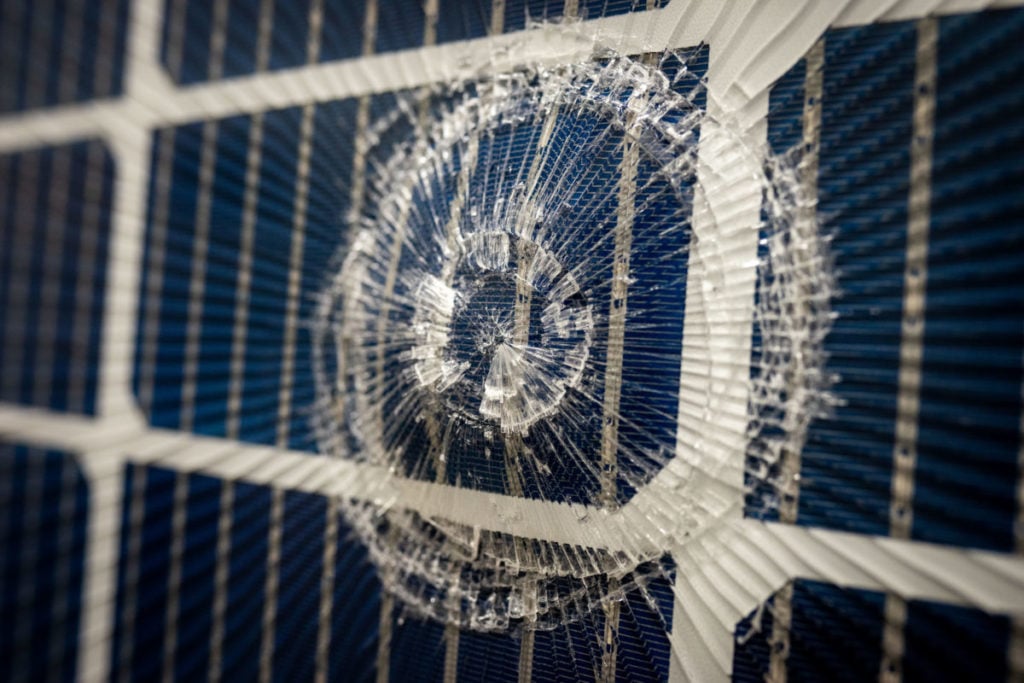
Field claims involving high glass breakage failure rates and frame structural failures have been continuously reported over the past years.
Glass breakage and hail damage have become some of the fastest‑growing causes of financial losses for solar asset managers.
Try Premium for just $1
- Full premium access for the first month at only $1
- Converts to an annual rate after 30 days unless cancelled
- Cancel anytime during the trial period
Premium Benefits
- Expert industry analysis and interviews
- Digital access to PV Tech Power journal
- Exclusive event discounts
Or get the full Premium subscription right away
Or continue reading this article for free
As manufacturers continue to deploy larger formats while sticking with thinner glass, modules are increasingly vulnerable to mechanical stress and hail damage, even when they meet existing IEC certification requirements. At the same time, climate trends are driving more extreme hail events.
In response, Kiwa PVEL has rolled out major updates to its Product Qualification Program (PQP) with two of the most important changes affecting Static Mechanical Load (SML) and hail testing.
Introducing a new static mechanical load test to failure
The PQP’s existing Mechanical Stress Sequence (MSS) surpasses IEC/UL certification for more thorough module and cell durability testing. It detects potential glass and cell cracking vulnerabilities, and frame structural weaknesses through static and dynamic load testing, followed by climate chamber testing to assess power output reduction due to cell cracks. While MSS was initially designed for sites facing extreme weather such as heavy snow and high winds, the many recent reports of glass breakage in the field during non-wind events make this test increasingly relevant for any environmental conditions
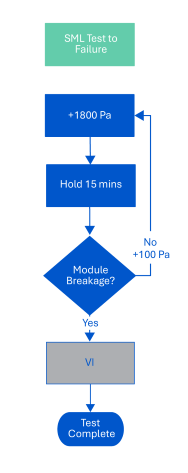
Under the new PQP, a Static Mechanical Load Test To Failure (SML-TTF) sequence has been added alongside the existing MSS test. Previous PQP statistics from the MSS, which will remain a key part of the PQP, could only reveal broad pass/fail rates over time, but could not effectively quantify the mechanical durability of different module designs, nor does MSS distinguish between good and best-in-class manufacturers.
The new SML-TTF test sequence focuses on resolving this limitation by quantifying the dominant failure mode and achievable maximum load for each bill of material (BOM) submitted to PQP testing. It also expands the test sample quantity (five additional samples for SML-TTF, on top of the two MSS samples), allowing for better statistical significance. In the new sequence, loads are increased progressively until glass breakage or structural failure occurs. This helps with easier identification of the breakage point/failure mode, not just whether damage happened.
For buyers, this translates into actionable insights. Instead of seeing that two modules passed SML, you can now compare how far beyond typical design loads each module survived. This is especially relevant for utility‑scale projects with single‑axis trackers, where more aggressive mounting is often employed.
Changing to hail testing to failure
Due to the brittle nature of glass, accurate assessment of mechanical strength requires large sample sizes and test-to-failure methods. Because of such limitations, the previous Hail Stress Sequence (HSS) test approach following the IEC61215-2:2021 standard (with 11 hail ball impact locations) could only effectively distinguish “atypically bad” from “normal” modules.
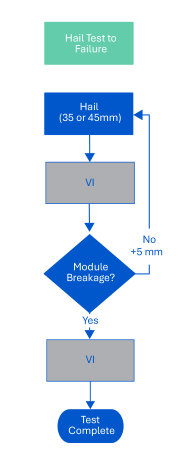
Due to the low sample size (of two modules per hail diameter) the previous hail test also had limited repeatability when comparing BOMs or, for example, comparing two glass suppliers of the same specs. Hail testing hundreds of modules in the recent years has allowed Kiwa PVEL to refine our new hail test to failure (Hail-TTF) protocol to focus on the module locations presenting higher failure rates (i.e. the edge, corner and junction box areas). This is coupled with an increased sample size of five modules, and, with a test-to-failure approach using increasingly large hail diameters, enabling better hail test repeatability.
Hail-TTF will start with 35mm ice balls for typical 2.0mm glass//2.0mm glass modules. Following six hail shots per module, if none of the five samples experience glass breakage, the test is repeated on the same samples using 40mm ice balls. Likewise, if there is still no broken modules following 40mm impacts, all five modules are tested again using 45mm ice balls. Modules using thicker glass (such as 3.2mm glass//backsheet, 2.5mm glass//2.5mm glass or 3.2mm glass//2.0mm glass) are tested in a similar sequence, but the initial ice ball diameter is 45mm.
Why this matters for solar buyers
As we’ve noted, 83% of manufacturers recorded at least one test failure in the 2025 PV Module Reliability Scorecard. This failure rate will be even higher in the forthcoming 2026 Scorecard, and is a testament to the fact that too many modules are not meeting expectations. As many of these failures are due to module breakage, more scrutiny must be placed on module durability and understanding how and when modules fail. The new test to failure approach will provide increased differentiation between module options that all claim compliance.
Kiwa PVEL’s updated PQP ensures that buyers, developers, and stakeholders have the rigorous, data‑driven insights they need to make confident procurement decisions. These updates reflect our ongoing commitment to advancing reliability requirements and supporting a more resilient global solar industry.
Tristan Erion-Lorico is VP of Sales and Marketing at Kiwa PVEL