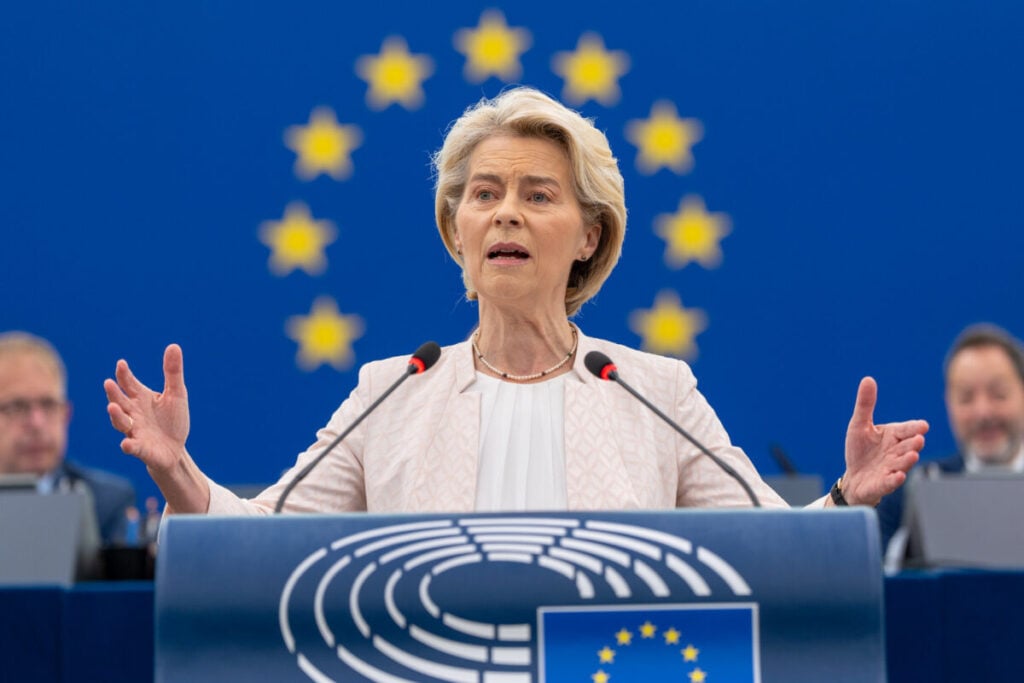
The European Commission has released its final Electrification Action Plan, a series of steps that intend to “make Europe the world’s first ‘electro-continent’,” according to commission president Ursula von der Leyen
The plan, which was leaked last week, aims for an electrification rate of 46% by 2040, double the current figure of 23% at which the EU has “stalled” over the last decade. In effect, this means Europe will redouble its efforts to build grid infrastructure and ensure bills are reduced. The commission noted that 70% of EU electricity is now generated from “homegrown clean energy sources”, and solar PV alone accounted for one-quarter of the EU’s domestic power generation last month.
Try Premium for just $1
- Full premium access for the first month at only $1
- Converts to an annual rate after 30 days unless cancelled
- Cancel anytime during the trial period
Premium Benefits
- Expert industry analysis and interviews
- Digital access to PV Tech Power journal
- Exclusive event discounts
Or get the full Premium subscription right away
Or continue reading this article for free
“The best way to reduce Europe’s fossil energy dependency is to power our economy with electricity from clean, homegrown sources,” said von der Leyen. “Today we are proposing to make Europe the world’s first electro-powered continent.”
Cutting bills is a key part of the Electrification Action Plan, and will be driven by continued deployment of renewable energy and a reduction in reliance on fossil fuel imports. The commission estimates that meeting the 46% electrification ate target will cut the EU’s fossil fuel import bill by €260 billion (US$297.2 billion) per year by 2040.
Indeed, the plan “encourages Member States to take actions” to ensure that the cost of domestic electricity bills is no more than two-and-a-half times the cost of gas, and no more than twice the price for industrial users, by 2030.
While the commission does not provide further details on the actions that could be taken to achieve this goal, other reporting suggests that more ambitious deployment of solar PV and battery energy storage systems (BESS) could make a significant impact on this target; earlier this year, a report from SolarPower Europe found that more deployments of the technologies could cut energy bills by 49% by the end of the decade.
‘Europe’s future runs on electricity’
“Europe’s future runs on electricity,” said SolarPower Europe CEO Walburga Hemetsberger, in response to the publication of the plan. “The commission has also taken important steps towards correcting the tax imbalance between electricity and fossil fuels, and recognising battery storage, flexibility and smarter grid use in network tariffs as essential pillars of a competitive and affordable energy system.”
However, she added that meeting Europe’s electrification target will require “clear investment and financial support,” through mechanisms like the Emissions Trading System (ETS), for which the commission also made new provisions last week.
This includes a new linear reduction factor (LRF)—the rate at which the ETS cap on annual carbon emissions reduces each year—which will be set at 3.7% between 2031 and 2035 and 1.7% between 2036 and 2040. These figures are both lower than the current LRF, which is set at 4.3% until next year, and the cap of 4.4% that will be in effect from 2028 to 2030.
Hemetsberger added that ETS-based financial instruments should “focus on de-risking of battery storage investments,” echoing sentiments expressed throughout European solar finance this year that co-location with BESS is becoming less risky. The Electrification Action Plan also reaffirms the EU’s belief that the EU will need 200GW of energy storage in place by 2030, as covered by our colleagues at Energy-Storage.news this morning.
Impacts on industry, manufacturing and grids
The EU’s Electrification Action Plan also says the commission will focus on using electrification technologies in European industries “that are already commercially viable”. Despite a slight month-on-month increase in its levelised cost of electricity (LCOE), solar PV remains one of the cheapest electricity generation technologies globally, so the latest EU directive could encourage a new wave of commercial and industrial (C&I) deployments in Europe.
The new plan will also “empower Member States to reduce network charges” for consumer groups and “taxes for energy-intensive businesses” as it looks to cut bills for both residential and C&I parties.
The commission also names the Net-Zero Industry Act (NZIA), an important piece of legislation in Europe’s efforts to re-establish a solar PV manufacturing sector, as a programme that will see new components. The NZIA will now benefit from guidance on the use of non-price criteria in renewable energy auctions to cut the price of power, and “increase the share” of renewable energy deployments across Europe.
Finally, the commission points to the European Grids Package, which was proposed last year, as a key tool to “speed up our grid deployment” and tackle the longstanding challenge in Europe that the pace of new renewable energy deployment is much faster than the pace of new grid additions, increasing the risk of curtailment and delays in renewable energy deployment as projects wait for grid connections.
However, the Electrification Action Plan involves few concrete measures to improve Europe’s grid capacity, apart from introducing more flexible transmission and distribution network charges that should “reduce overall costs for consumers”. Earlier this year, PV Tech heard that greater private investment in Europe’s grid infrastructure could be necessary to build out the scale of new grid additions required to accommodate the scale of renewable energy capacity that is coming online.