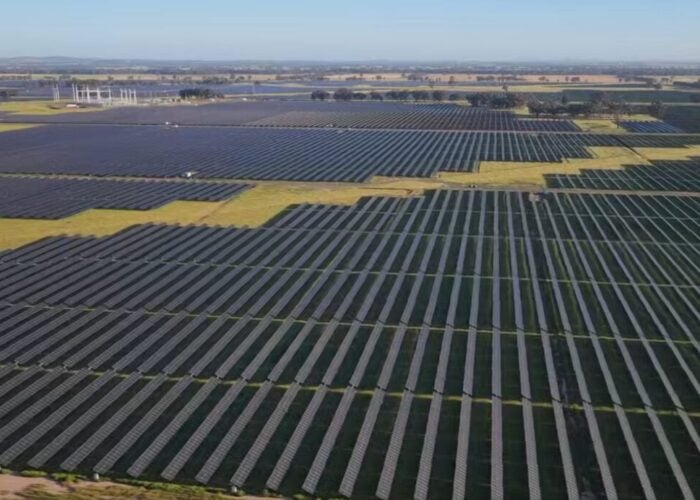
Fotowatio Renewable Ventures (FRV) Australia has announced the development of a 210MWdc solar project in New Zealand’s Rangitikei District.
The Rangitikei solar project, located on New Zealand’s North Island, represents FRV Australia’s largest announced development in the country to date. The announcement also coincides with the conclusion of FRV’s joint venture with Genesis Energy, an agreement that had facilitated FRV Australia’s entry into the New Zealand market.
Try Premium for just $1
- Full premium access for the first month at only $1
- Converts to an annual rate after 30 days unless cancelled
- Cancel anytime during the trial period
Premium Benefits
- Expert industry analysis and interviews
- Digital access to PV Tech Power journal
- Exclusive event discounts
Or get the full Premium subscription right away
Or continue reading this article for free
The original joint venture, established in late 2021, aimed to develop up to 500MW of solar capacity across New Zealand over five years.
FRV Australia, a developer of sustainable energy solutions owned by Saudi Arabia’s Jameel Energy and the Canadian infrastructure fund OMERS, will proceed with the Rangitikei project independently. The company operates under the broader FRV portfolio, which has established operations across multiple international markets.
According to the company’s announcement, the Rangitikei project is in “active development,” though the initial announcement did not disclose specific details regarding construction timelines, grid connection arrangements, or power purchase agreements.
However, the announcement did confirm that the project will create local employment, with a peak of 250 jobs and an average of 75 workers over an expected 24-month construction period.
In addition, the project design also includes the potential for future integration of a battery energy storage system (BESS), which will enhance grid flexibility and resilience. The size of the BESS has not been disclosed.
Carlo Frigerio, CEO of FRV Australia, said the project “contributes to FRV Australia’s vision of leading the energy transition in this region, supporting local economic development, and contributing to the green electrification goals of Aotearoa.”
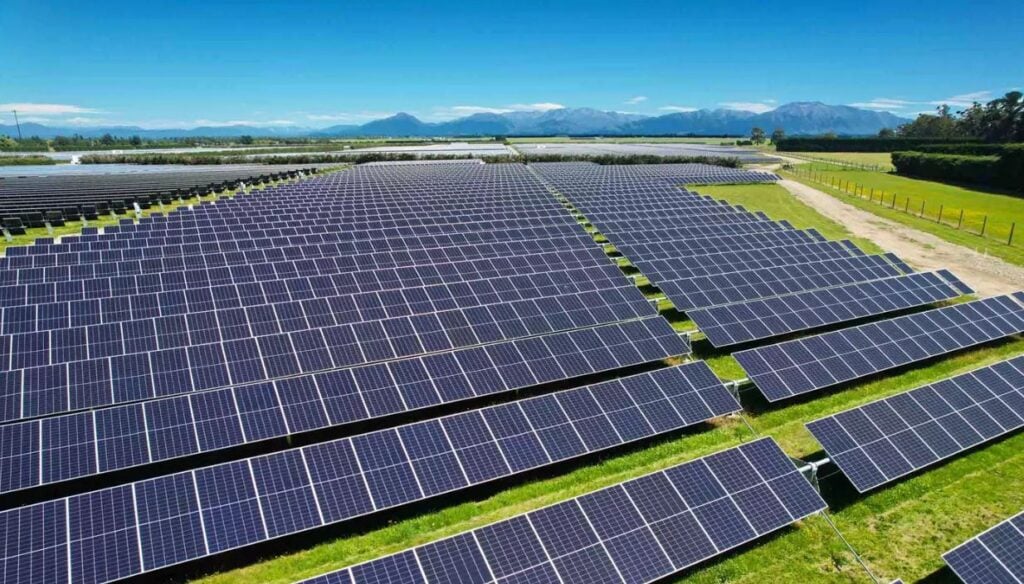
Despite ending their development partnership, FRV Australia and Genesis Energy will continue joint ownership and operation of the Lauriston Solar Farm in Canterbury. The 63MW Lauriston project, which began generation in April 2025, was delivered on time and on budget as the partnership’s primary completed project.
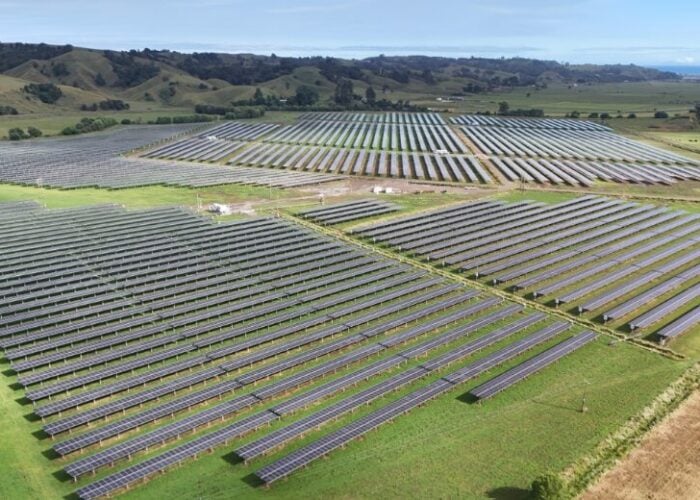
The site, featuring over 90,000 solar PV modules spread across a 93-hectare site, is located west of Christchurch on New Zealand’s South Island, near the Rakaia River in the Canterbury Plains area.
The Lauriston facility represented New Zealand’s largest solar installation at the time of completion, though larger projects are now under development. For instance, the 179MWdc Glorit solar PV plant recently cleared regulatory hurdles with Environmental Protection Authority consent.
FRV Australia again expressed gratitude for Genesis Energy’s role during their joint venture period, noting that the relationship facilitated valuable market entry and project development experience.
Genesis Energy, meanwhile, has indicated plans to focus on building capabilities for smaller, distributed solar projects rather than utility-scale developments.
The Rangitikei project adds to FRV Australia’s broader portfolio, which includes eight operational solar farms across Australia, totalling over 900MW of capacity. Indeed, the company recently completed the 300MW Walla Walla Solar Farm in New South Wales, its largest Australian project to date, under a power purchase agreement with Microsoft.