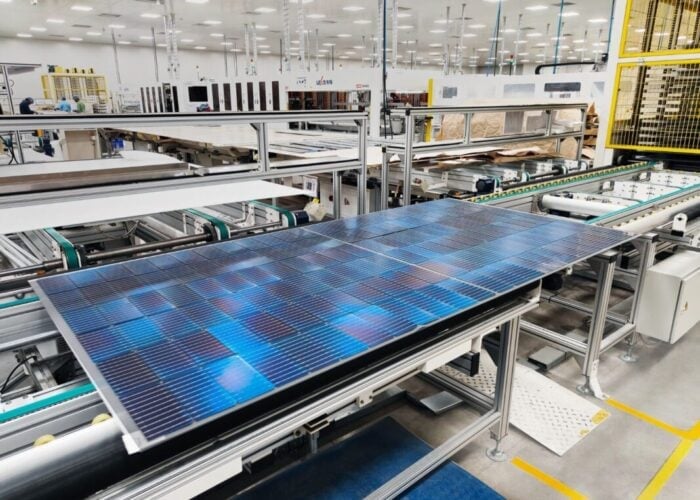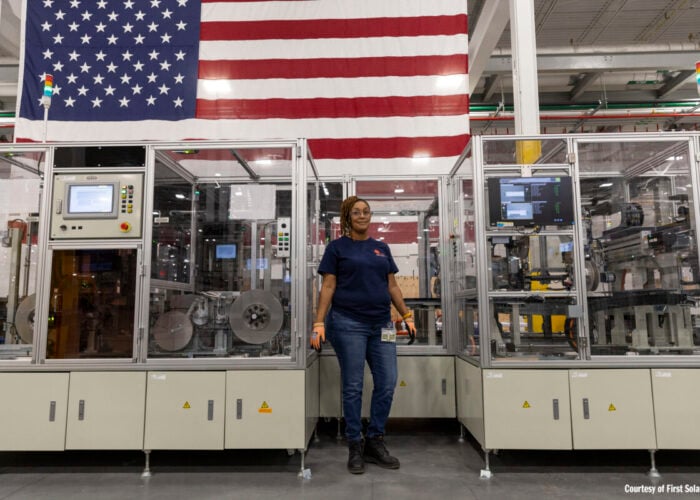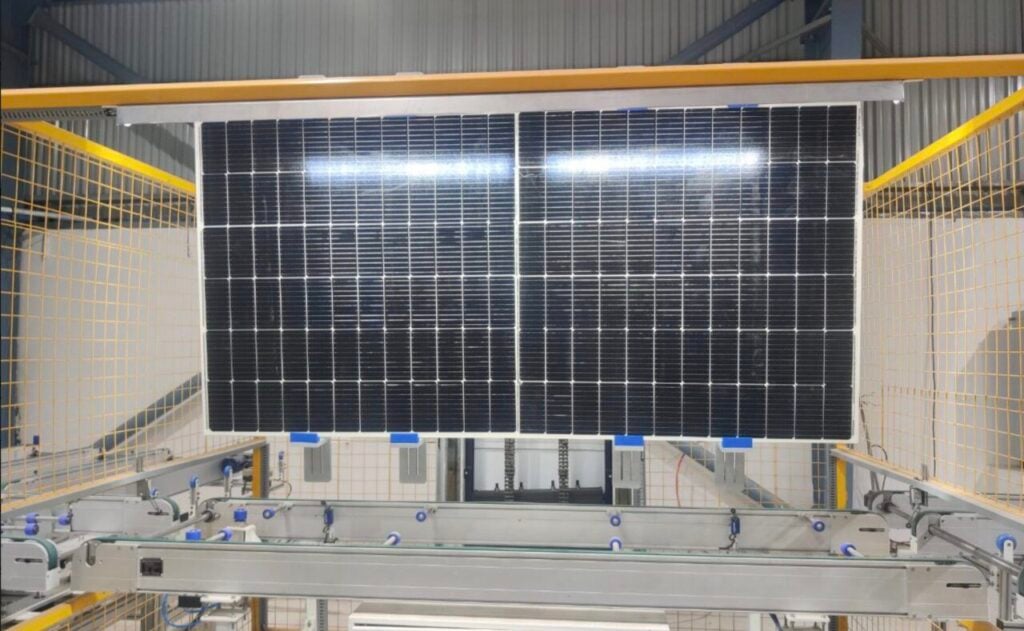
Indian manufacturing conglomerate Group Surya has commissioned a G12R solar module manufacturing facility in Odisha, the first such manufacturing facility in the Indian state.
The facility has an annual manufacturing capacity of 500MW, for modules between 450-735W, which the company says will enable the facility to serve the utility-scale, commercial and residential sectors. Group Surya also noted that the plant has “multi-technology compatibility”, including tunnel oxide passivated contact (TOPCon) and heterojunction technology (HJT) modules, of the G12R dimensions.
Try Premium for just $1
- Full premium access for the first month at only $1
- Converts to an annual rate after 30 days unless cancelled
- Cancel anytime during the trial period
Premium Benefits
- Expert industry analysis and interviews
- Digital access to PV Tech Power journal
- Exclusive event discounts
Or get the full Premium subscription right away
Or continue reading this article for free
The company claimed the facility includes a “100% automated production line” and that its modules have an “ultra-low breakage rate”, with fewer than five defects reported per 10,000 modules produced.
“This commissioning marks a significant step in our strategic roadmap to build globally competitive manufacturing capabilities aligned with the government of India’s Atmanirbhar Bharat vision and Make in India,” said group director Kamlesh Kumar Singh.
Group Surya’s contribution to this “vision” will include the doubling of the capacity of the Odisha plant to 1GW within the next four to five months. According to the country’s Ministry of New and Renewable Energy (MNRE), India added 81GW of new module manufacturing capacity in 2025, almost double the 41GW added the previous year.
There has been a similar growth in domestic cell manufacturing capacity, with the MNRE adding 3GW of solar cell capacity to its Approved List of Models and Manufacturers (ALMM), a database of domestically-produced cells and modules, earlier this year.
This push towards domestic manufacturing capacity comes at a time of increasing global supply chain uncertainty. While several Indian solar manufacturers told PV Tech last week that the impact of the US’ new countervailing duties would be “limited”, the imposition of tariffs of 125.87%, compared to the 18% ‘reciprocal’ tariffs agreed between the US and India earlier last month, is striking.
This week, figures from Mercom revealed that the cost of using Indian-made solar modules in Indian projects fell 3.4% quarter-on-quarter at the end of 2025.