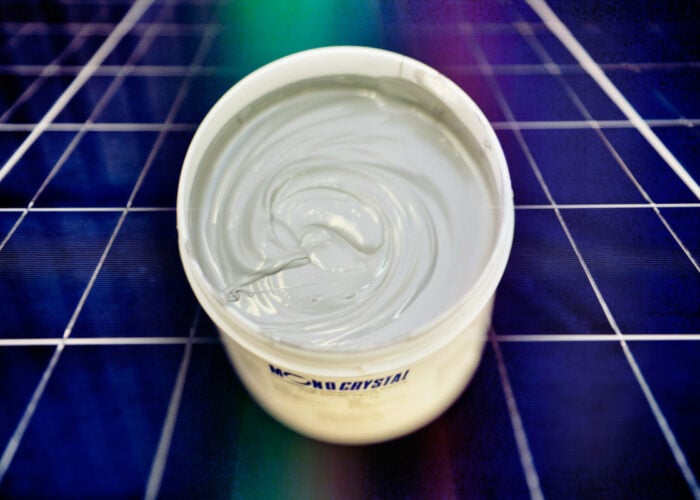
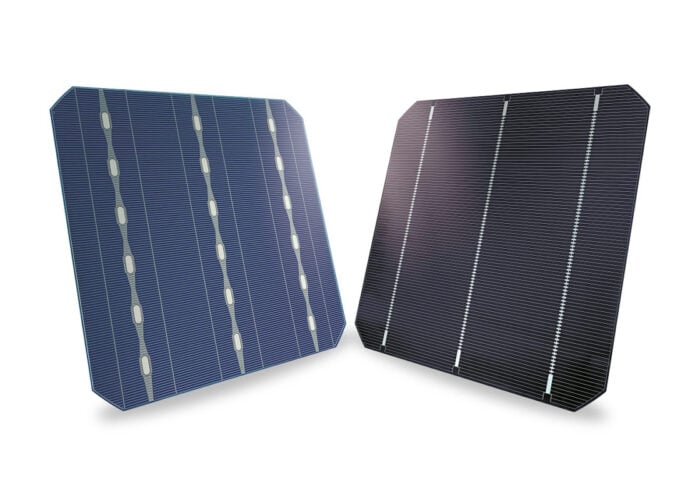
Monocrystal has launched its new MY-555 cost-saving back-side silver metallization paste for Passivated Emitter Rear Contact (PERC) solar cells. MY-555 was specially developed to meet the demand for product with efficient balance of silver content and paste consumption.
Polysilicon producer REC Silicon ASA reported a 106% increase in its polysilicon sales volume in the fourth quarter of 2016, due to an overall strong demand pick-up in the late last year.
High-efficiency PV module producer and project developer SunPower has reached a production average cell conversion efficiency of 25% at its Fab 4 facility in the Philippines, the highest in the industry.
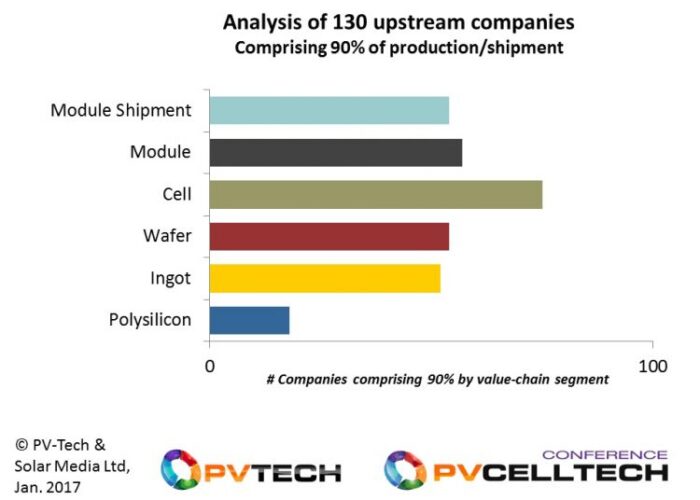
At the start of each year, when market observers do their annual look at the year ahead, there is normally always a vague statement about some type of widespread consolidation of companies set to unfold.
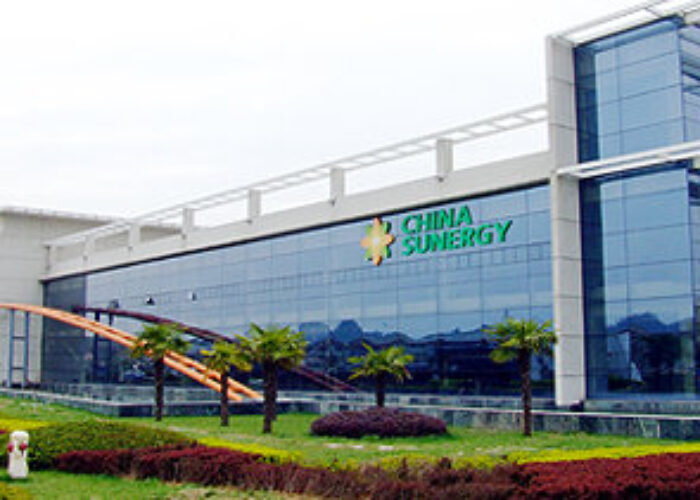
China-headquartered solar cell and module manufacturer China Sunergy (CSUN) said in a joint statement with the California Governor’s Office of Business and Economic Development (GO-Biz) that it was establishing a solar module assembly facility at the McClellan Business Park near Sacramento, California.
Specialist PV manufacturing equipment supplier Amtech Systems highlighted the confidence it had in a series of major new orders for high-efficiency n-type PERC and n-type bi-facial cell equipment including the first of a multi-phase 1GW turnkey project order during the reporting of its first 2017 fiscal quarter.
Integrated PV manufacturer SolarWorld is to shift its production focus to monocrystalline PERC (Passivated Emitter Rear Contact) cells and modules and away from multicrystalline to build economies of scale with high-efficiency only products. With the realignment of production to mono PERC products, including bifacial modules, around 400 jobs would be lost by the end of 2019.
Thin film perovskite solar cell developer Dyesol has had an application granted by the Australian government for a AUD$2.5 million (US$1.9 million) in funding for an 18 month project to develop a large-area on glass product prototype that would coincide with the company establishing pilot line production in Australia.
China-based polysilicon producer Daqo New Energy said it had started production at its Phase 3A facility, bringing an extra 6,000MT of polysilicon capacity online and an annual production run rate of 18,000MT.