Europe will not be able to produce a “disruption” in the solar manufacturing industry, but will instead need to focus on innovation and strategic areas of development, according to Peter Fath, CEO of RCT Solutions.
Speaking at Intersolar Europe 2026 in Munich yesterday, Fath explained that the next decade of solar technology evolution would unfold on a reliable path—from the domination of tunnel oxide passivated contact (TOPCon) and replacement of passivated emitter rear contact (PERC) today, to the growing market share of back contact (BC), along with some heterojunction (HJT) and silicon-perovskite tandem products by 2035.
Try Premium for just $1
- Full premium access for the first month at only $1
- Converts to an annual rate after 30 days unless cancelled
- Cancel anytime during the trial period
Premium Benefits
- Expert industry analysis and interviews
- Digital access to PV Tech Power journal
- Exclusive event discounts
Or get the full Premium subscription right away
Or continue reading this article for free
Those technologies are likely to meet the projected growth in global solar demand over the next decade, leaving no room for what Fath called a “European disruption” to the industry’s tech roadmap.
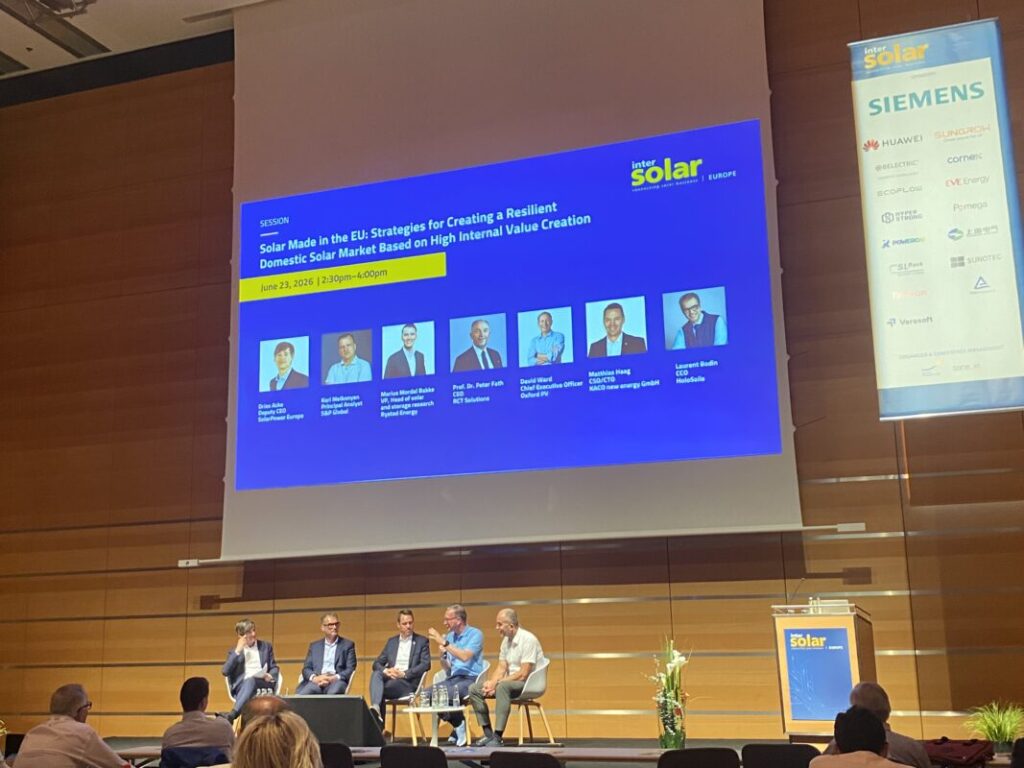
However, Fath and his fellow speakers in the ‘Made in EU’ session at yesterday’s show all emphasised the strategic importance of a credible European solar manufacturing base.
The EU should rely on “innovation” and specific market segments to establish and retain the “security and resilience” of meaningful solar manufacturing, Fath said. The continent already has a bulk of domestic solar inverter production capacity, but should look to equipment manufacturing, complex cell processes like coatings and advanced solar cell technologies, and “high-precision” machinery to secure its competitive edge, he explained.
A March study by solar research bodies Fraunhofer ISE and ISC Konstanz found that Europe had the potential to supply high-quality PV manufacturing equipment to major emerging markets like India and the US in the coming years, as the equipment sector enters a period of unprecedented growth. The move towards newer, higher-efficiency technologies like BC could give the continent a strategic advantage, given the quality of its machinery production, but success will rely on supportive structures.
“We need market protection [alongside] brave people who are deploying CAPEX,” Fath said.
Robust language around inverters
In an announcement today, Austrian inverter producer Fronius said that it could scale up its operational European manufacturing capacity to 17GW “within six to 12 months”, if the EU issues “clear and reliable framework conditions from European policymakers.”
The company would back Europe-wide restrictions on Chinese inverters and digital power infrastructure, a spokesperson has confirmed to PV Tech, expanding on the European Commission’s earlier decision to withhold its funding from any projects that use Chinese inverters.
Inverters have been the central component in efforts to support European manufacturing, due to both their strategic importance and the existing manufacturing base. PV Tech Research recently estimated that the EU had surpassed 100GW of inverter production capacity.
Brussels’ recent policy moves have put some legislative heft behind EU-made and non-Chinese products, such as the Industrial Accelerator Act (IAA) and Net Zero Industry Act (NZIA). As it stands, these laws mandate non-Chinese products in public auctions, but do not extend to the wider market.
A Europe-wide restriction on Chinese inverters would be a big change for Europe—a big move towards protectionism and away from the EU’s free market underpinnings. But Fronius, and others, argue that the issue of solar inverters is bigger than market dynamics and economic competition, as the influx of Chinese products into Europe after 2022 increases the cybersecurity risks to the continent’s grid. Fath said that excluding Chinese-made inverters from the European grid is a “must”.

“Every inverter manufacturer can control its products remotely,” Fronius said in its statement. “This has direct implications for data sovereignty, system integrity and control over software updates.”
PV Tech has covered the EU’s changing stance on inverter cybersecurity extensively, which you can find here.
It may be unlikely that a broad limit on Chinese access to the inverter market is in the works, but Dries Acke, deputy CEO of SolarPower Europe, said yesterday that his organisation “does not like” the fact that the IAA’s definition of “made in Europe” includes markets with which the bloc has free trade agreements and customs unions. Crucially, this includes India and Turkey, where solar products are manufactured in greater quantities than mainland Europe, and would affect both inverters and solar cells, the two “resilience” components outlined in the EU’s legislation.
Cells and Chinese collaborations
Speaking at Intersolar yesterday, Fath said that technological innovation and cell technologies could still prove a fruitful area for European manufacturers.
He shared the stage with David Ward, CEO of perovskite-silicon tandem specialist Oxford PV. Ward said he expected the start of “gigawatt scale” tandem production in 2028, describing the technology as a potential “hidden disruptor”, as it could theoretically transform existing silicon manufacturing lines without needing fundamentally new capacity or facilities, as perovskite thin films are laid on top of silicon base cells.
Laurent Bodin, CCO of French PV manufacturing startup HoloSolis, said that the EU had “one chance” to capitalise on the future of PV manufacturing through tandem technology, as the expertise for perovskites is still largely in Europe, through firms like Oxford PV, research institutes like Fraunhofer and other projects. The argument that Europe could pursue innovation as a means for global PV manufacturing relevance isn’t new; Ward himself made it in conversation with PV Tech Premium in 2024.
However, in May, Alex Barrows, head of PV at CRU, contributed to a guest blog for PV Tech that pointed to the sheer scale of R&D power in big Chinese manufacturers. The time required to bring tandem products to market may lessen Europe’s strategic advantage for next-generation solar.
Conversation yesterday turned to joint ventures (JV) with Chinese companies, of which HoloSolis itself serves as an example, having inked a deal with Trina Solar. “We must be humble,” Bodin said, and accept JVs with Chinese companies to facilitate manufacturing in Europe at scale. He said European companies could “learn from” their Chinese counterparts, before expanding more independent capacity.
This notion raises some eyebrows, as the involvement of the major Chinese manufacturers in supposedly “European” projects muddies the waters. The IAA does impose a 49% cap on ownership of EU solar projects by dominant supplier nations, which effectively means China.
Read all of our coverage of Europe’s biggest solar trade show here.