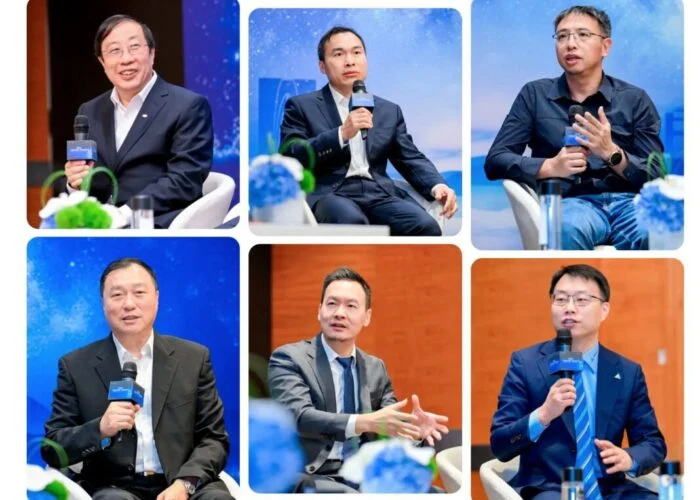
“What is commercially available today passed mass production verification two to three years ago. The eight new technologies unveiled today reflect five to ten years of R&D, and what’s still in the lab, not yet disclosed, is already shaping the next decade,” said Li Zhenguo, founder and CTO of LONGi. He outlined the company’s full-cycle innovation philosophy at the 2026 PV & Energy Storage Innovation Technology Launch co-hosted with Shanghai Jiao Tong University on 14 July.
At the event, LONGi unveiled what it is dubbing its “technology forest” suite of new innovations, with eight cutting-edge technologies making a debut. Leading the lineup is the ACM (Advanced Contact Matrix) nano-alloy matrix contact technology, which LONGi announced last week had reached gigawatt-scale mass production at its Xixian base. As the core pillar of the technology ecosystem, ACM tackles long-standing PV metallisation bottlenecks and offers a mass-production solution to the industry’s trilemma of high efficiency, low cost and high reliability.
Try Premium for just $1
- Full premium access for the first month at only $1
- Converts to an annual rate after 30 days unless cancelled
- Cancel anytime during the trial period
Premium Benefits
- Expert industry analysis and interviews
- Digital access to PV Tech Power journal
- Exclusive event discounts
Or get the full Premium subscription right away
Or continue reading this article for free
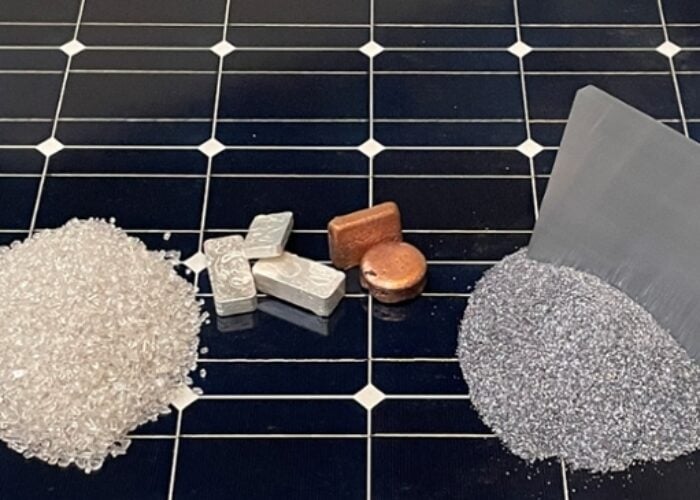
Amid cutthroat market competition, capacity expansion can no longer mask fundamental technical bottlenecks. Metallisation pain points have become a key barrier to cost reduction, efficiency gains and long-term sustainability. For decades, crystalline silicon cells have relied on silver paste for gridline conductivity—a precious metal that inflates costs and threatens supply chain stability.
Reports from BloombergNEF, the World Silver Institute and SMM all point to the same trend. Silver paste has overtaken silicon as the top PV module cost, accounting for nearly 30% of the total costs. Global PV silver consumption exceeds 6,000 tons annually—over a quarter of industrial silver demand. With concentrated supply and sharp price swings, each US$1/oz change shifts per-watt costs by RMB0.003-0.005, translating into tens of millions of yuan in annual cost volatility for GW-scale plants, severely squeezing profit margins.
To curb silver consumption, the industry has turned to ultra-fine gridlines, shrinking the width from over 100 microns to below 20 microns. However, this brings inherent trade-offs: thinner lines reduce conductive cross-section, driving up series resistance and cutting cell efficiency. Their fragile mechanical strength also invites grid breakage and cold soldering during production, transport and long-term use. Electroluminescene inspections frequently reveal widespread dark spots and localised overheating, significantly shortening module lifespan.
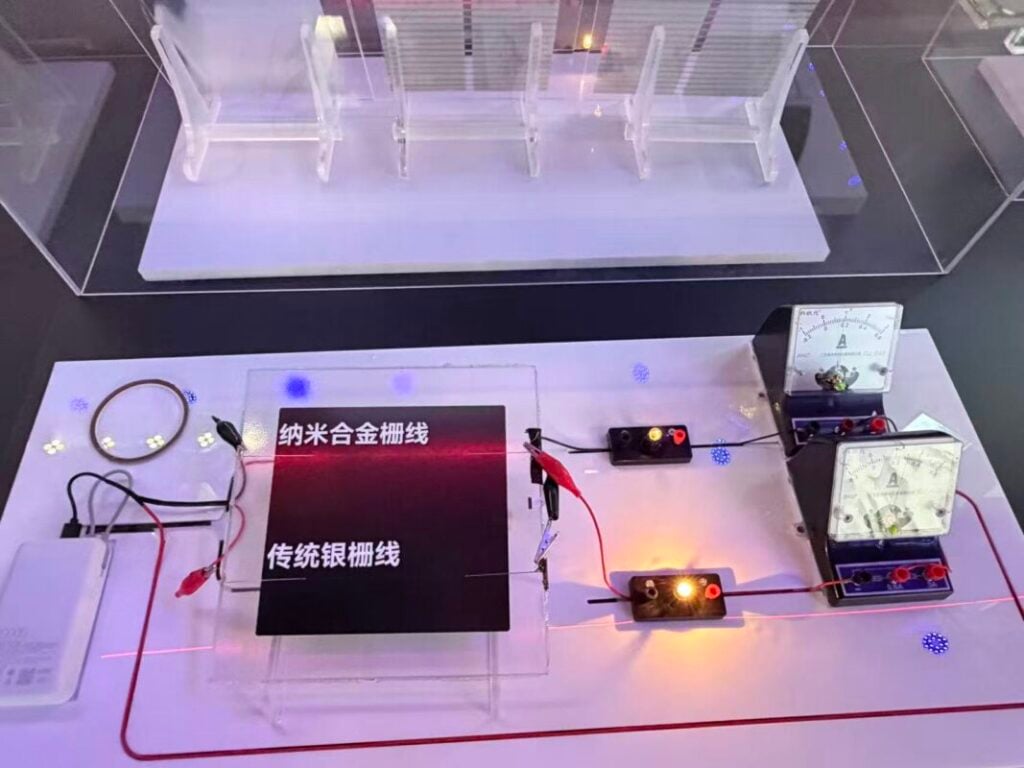
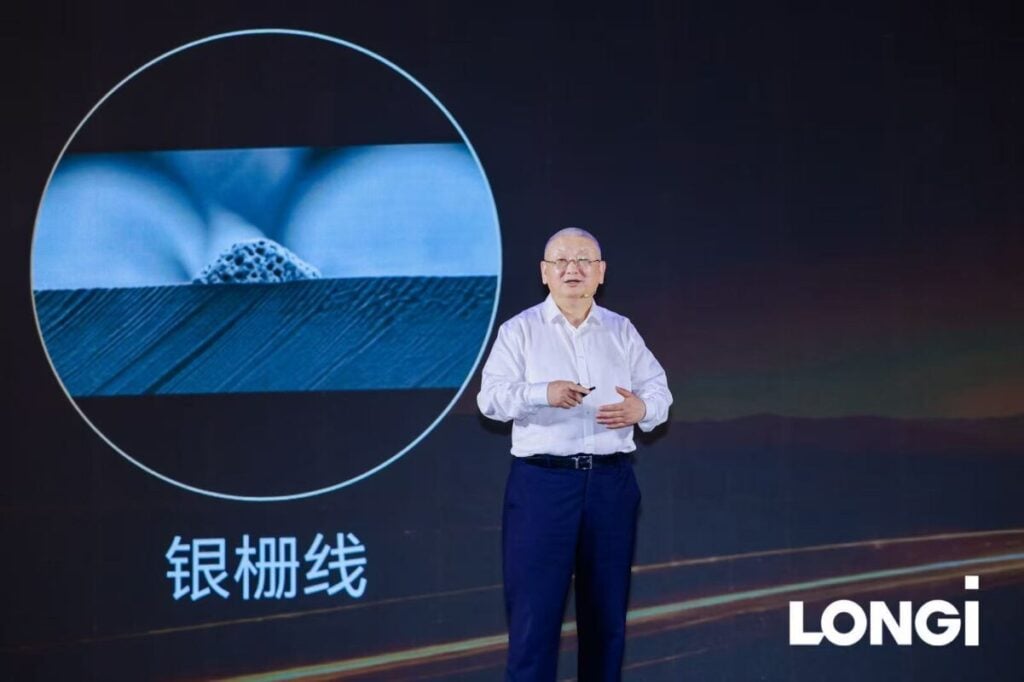
LONGi’s proprietary ACM technology is a next-generation gridline solution that features major advances in materials and processes. Using patented nano-alloy materials and a novel matrix-contact design, it enhances the efficiency and reliability of cells and modules.
Li Zhenguo noted that LONGi’s ACM nano-alloy matrix contact technology—developed over nearly a decade—has entered mass production. The solution fundamentally re-engineers gridline design and manufacturing at the material level, fully breaking the industry’s long-standing dependence on conventional silver paste.
According to LONGi, ACM is a fully self-developed gridline innovation built on two pillars: proprietary materials and matrix-structured process. Its exclusive nano-alloy formulation and nano-scale anti-oxidation coating replace traditional silver paste, slashing gridline resistance to half that of conventional TOPCon silver grids. The conductive pathway evolves from a limited dual-path design to a high-efficiency multi-path network, drastically reducing transmission losses.
On the process side, ACM features a partitioned matrix contact design. The current collection layer minimises contact area to curb carrier recombination, while the transmission layer ensures uniform, efficient output. This clear division of labour resolves the inherent trade-off of conventional gridlines, which are forced to handle both collection and conduction in a single structure.
Since its mass deployment, LONGi said ACM has unlocked three core industrial values. On efficiency, the combination of low resistance, optimised passivation, and matrix structure boosts cell conversion efficiency by 0.2-0.3%, with single-module peak power reaching 672W. Paired with seven other “Technology Forest” innovations—including integrated conductive backsheet and shingled cell—standard-size modules can exceed 690W with a conversion efficiency of 25.54%, creating a clear market edge.
On reliability, ACM doubles the busbar soldering area and supports the back contact cell inline-welding structure, fundamentally reducing cold soldering and grid-break risks, with failure rates down 80%, according to LONGi. The nano-antioxidation coating blocks moisture and oxygen, curbing lifetime power degradation and enabling 30-year warranty compliance.
On power generation economics, ACM cuts conductive losses for more stable output under identical irradiance. Combined with smart modules and storage scheduling, it boosts life-cycle generation and directly lowers levelized cost of energy (LCOE).
As a core enabler of LONGi’s BC roadmap, ACM mass production fills a critical gap in BC cell scaling. Professor Shen Wenzhong, director of the Institute of Solar Energy at Shanghai Jiao Tong University, noted at the conference that BC cells—with a front grid-free structure—offer a 29.1% theoretical efficiency ceiling and strong scalability. He added that silver-paste replacement is an irreversible long-term trend, and while perovskite tandems face near-term stability constraints, the BC roadmap has an eight to ten-year golden window.
As of the end of 2025, LONGi held 510 BC-related granted patents, including 330 inventions. The company targets nearly 100GW in cumulative BC module shipments globally by the end of 2026.
Li Zhenguo noted that ACM’s deep compatibility with BC cells removes metallisation cost and reliability hurdles for BC scale-up, enabling smooth mass production of LONGi’s Hi-MO X10 Pro module. The first “Technology Forest” end-product, powered by ACM, delivers 670W and 24.7% conversion efficiency, with omnidirectional anti-soiling, wind resistance, and anti-dent performance. Transport and installation costs are also optimized, accelerating innovation-to-product translation.
ACM is not a standalone technology but a core branch of LONGi’s “Technology Forest.” The eight technologies unveiled—integrated conductive backsheet, shingled cell, hidden busbars, selective temperature alloy connection (STAC), smart module, LONGi One OS,and Hi-MO X10 Pro Modules—work in synergy with ACM. ACM cuts internal cell losses; the integrated conductive backsheet eliminates solder ribbons and reduces overall module gridline losses via surface contact; shingled cell and hidden busbars maximise light capture; smart modules and the PV-storage platform unlock system-level revenue gains.
Li Zhenguo explained that the core strength of the Technology Forest lies in modular flexibility—its technologies can be freely combined for tailored solutions across decentralised, utility and PV-storage projects, driving full-chain performance upgrades from cells and modules to energy systems.
At the conference, LONGi announced that its silicon-perovskite tandem solar cell achieved an ESTI-certified efficiency of 35.5%—a new world record. This confirms that the evolving technology ecosystem can sustain long-term R&D for next-generation PV roadmaps.
The PV industry may be cyclical, but technological innovation endures. Li Zhenguo’s R&D philosophy—deploying cutting-edge technologies five to ten years ahead of the market—has been fully validated by ACM technology.
Marking the launch, Zhong Baoshen, chairman and general manager of LONGi, said that technological innovation is the first principle of the PV industry: “Only technological innovation can pull the PV sector out of vicious price competition and unlock sustained growth potential.”