Chinese module manufacturer LONGi’s crystalline silicon-perovskite tandem solar cell has achieved a power conversion efficiency of 35.5%, according to certification by the European Solar Test Installation (ESTI).
Crystalline silicon-perovskite tandem cells are widely regarded as a leading technology pathway for next-generation high-efficiency photovoltaics. By combining a perovskite top cell with a crystalline silicon bottom cell, tandem architectures offer a higher theoretical efficiency limit than conventional single-junction silicon solar cells.
Try Premium for just $1
- Full premium access for the first month at only $1
- Converts to an annual rate after 30 days unless cancelled
- Cancel anytime during the trial period
Premium Benefits
- Expert industry analysis and interviews
- Digital access to PV Tech Power journal
- Exclusive event discounts
Or get the full Premium subscription right away
Or continue reading this article for free
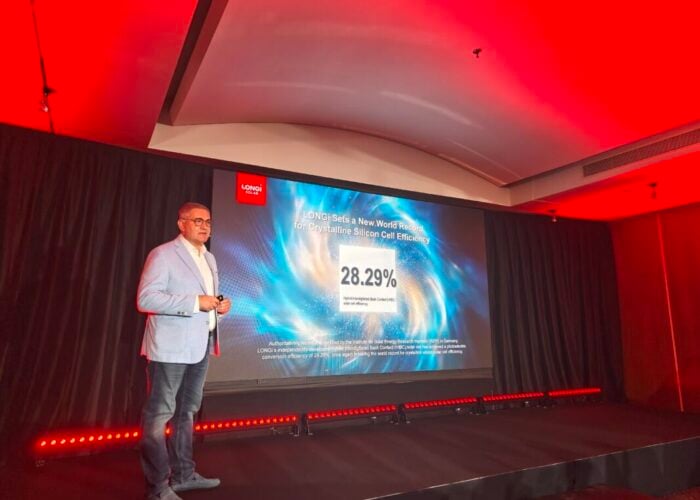
The company disclosed the result at the 2026 Solar and Energy Storage Innovation Conference, stating that it represents a new record for the technology.
The latest result follows a series of efficiency improvements reported by LONGi over the past three years. The company said its tandem cell reached 33.9% efficiency in November 2023 before increasing to 34.6% in June 2024. It subsequently reported efficiencies of 34.85%, 35.2% and now 35.5%.
The company also reported efficiencies of 34.3% for a 261cm² tandem cell and 32.2% for a 274cm² tandem cell, results intended to demonstrate performance at larger device sizes.
For tandem modules, LONGi said it has achieved conversion efficiencies of 31.4% and 29.4%, with both results independently certified and included in the latest edition of the Solar Cell Efficiency Tables.
In May 2026, LONGi’s 35.2%-efficient two-terminal crystalline silicon-perovskite tandem cell was included in the 68th edition of the Solar Cell Efficiency Tables, compiled by a team led by Professor Martin Green at the University of New South Wales.
This was by another announcement by the manufacturer, where LONGi said its hybrid interdigitated back contact (HIBC) cell achieved a conversion efficiency of 28.13%, improving on its previous record of 28.04% set in January. The result was certified by the Institute for Solar Energy Research Hamelin (ISFH) in Germany.
LONGi also said modules fabricated using the cells achieved a conversion efficiency of 26.4%, up from its previous record of 26%. The module result was certified by the US National Laboratory of the Rockies (NLR).
Last month, at Intersolar Europe 2026, the Chinese firm launched its Hi-MO 9 Prime module series, featuring a power output of 680W and a module conversion efficiency of 25.2%.