Imec pushes perovskite tandem silicon mini-module to record 23.9% conversion efficiency

Facebook
Twitter
LinkedIn
Reddit
Email
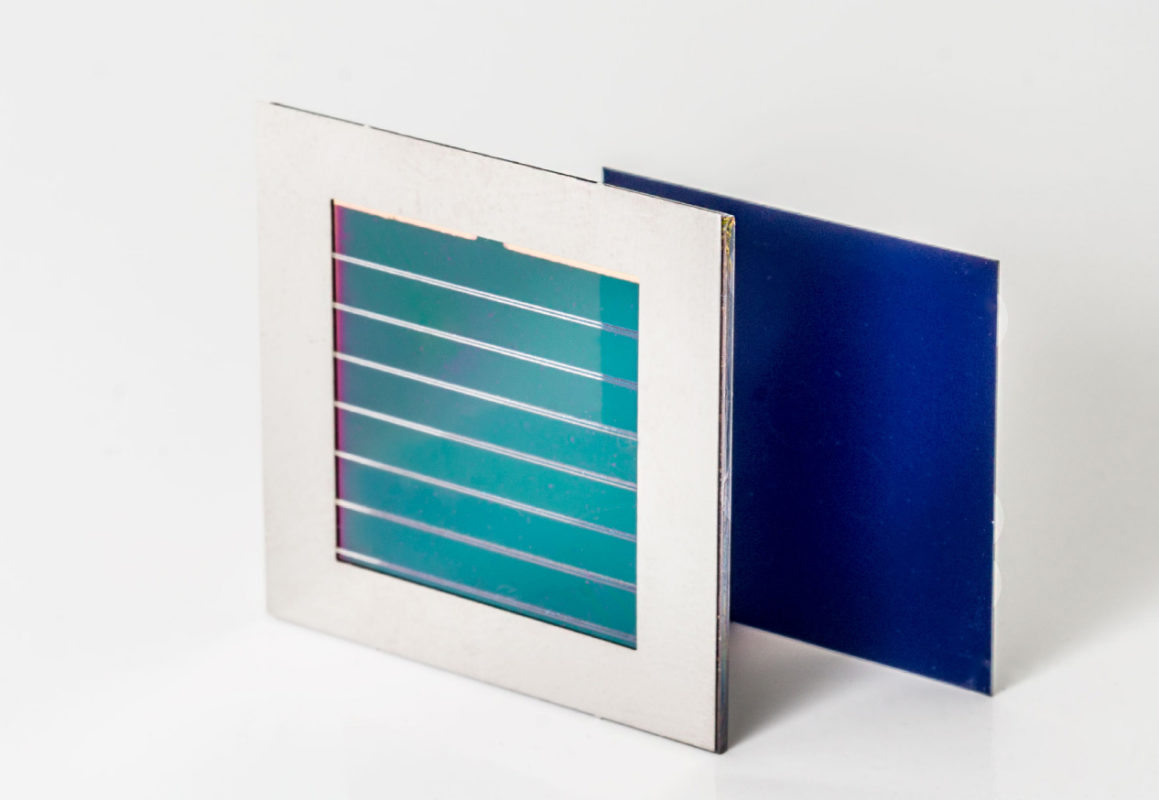
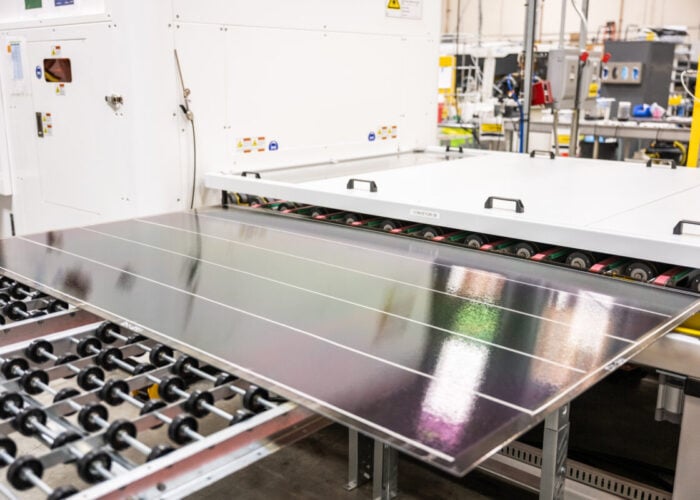
Several new engineering tricks were used to boost the tandem mini-module to 23.9% conversion efficiencies, which included a better engineered perovskite material (CsFAPbIBr), an anti-reflection texturing process on the surface of the module as well as depositing a higher (air, 1.44) refractive index matching liquid between the perovskite module and IBC silicon cell. Image: imec

Nanoelectronics research centre imec has taken a perovskite/silicon tandem mini-module-on-cell stack to a record 23.9% conversion efficiency, significantly exceeding its 20.2% efficiency figures reported in 2016. 

In 2016, imec used a semi-transparent perovskite mini-module, which was developed in collaboration with Solliance that was stacked on top of a high-efficiency interdigitated back-contact (IBC) crystalline silicon solar cell in a four-terminal tandem configuration with an aperture area of 4cm2 to produce 20.2% conversion efficiency.

This article requires Premium SubscriptionBasic (FREE) Subscription

Try Premium for just $1

  • Full premium access for the first month at only $1
  • Converts to an annual rate after 30 days unless cancelled
  • Cancel anytime during the trial period

Premium Benefits

  • Expert industry analysis and interviews
  • Digital access to PV Tech Power journal
  • Exclusive event discounts

Or get the full Premium subscription right away

Or continue reading this article for free

Several new engineering tricks were used to boost the tandem mini-module to 23.9% conversion efficiencies, which included a better engineered perovskite material (CsFAPbIBr), an anti-reflection texturing process on the surface of the module as well as depositing a higher (air, 1.44) refractive index matching liquid between the perovskite module and IBC silicon cell.

“Two innovations are key to this achievement,” explained Tom Aernouts, group leader for thin-film photovoltaics at imec and perovskite PV program manager at Solliance. “First, a different perovskite material (CsFAPbIBr) was used, largely improving the stability and conversion efficiency of the 4cm² semi-transparent perovskite module to 15.3 percent. Second, the architecture of the stack was optimized for minimal optical losses by adding an anti-reflection texture on top of the module and a refractive index matching liquid between the perovskite module and the Si solar cell.”

Imec noted that the four-terminal tandem mini-module had matched aperture areas as large as 4cm2 for the perovskite module and the Si solar cell.

“Having matched areas of this size makes the fabrication technology more attractive to the solar cell industry,” added Aernouts. “For reference, we have also fabricated a stack of a small perovskite cell (0.13cm2) on top of an IBC c-Si cell (4cm2). In this configuration, the power conversion efficiency of the small semi-transparent perovskite cell is 16.7 percent, outperforming the larger 4cm2 perovskite module due to better perovskite layer properties. Although less attractive from an industrial point of view, the overall power conversion efficiency of this cell-on-cell stack is as high as 25.3 percent.”

Imec believes that by stacking the perovskite solar cells or modules on top of silicon solar cells is a key route to eventual commercialisation of perovskite material options with power conversion efficiencies potentially above 30% with the opportunity to be relatively low cost for tandem cell roadmaps.
13 October 2026
San Francisco Bay Area, USA
PV Tech has been running an annual PV CellTech Conference since 2016. PV CellTech USA, on 13-14 October 2026 is our fourth PV CellTech conference dedicated to solar manufacturing in the USA. From polysilicon, wafers, ingots, cells and modules, to critical component suppliers including glass and frames, the event connects every stage of the value chain under one roof. PV CellTech USA also brings together investors, innovators, manufacturers and industry stakeholders to collaborate and strengthen domestic solar manufacturing across the United States.
20 April 2027
Istanbul, Türkiye
PV Tech has been running PV CellTech Conferences since 2016. PV CellTech Global, on 20-21 April 2027, is the meeting place for everyone invested in the growth of PV manufacturing and advancement in cell technologies, which will drive us towards the installed capacity required to power the planet by 2050. This is a gathering of key stakeholders driving capital expenditure and technologies for new PV manufacturing plants across the globe to harness the opportunities the growth of PV represents out to 2050 and beyond. The conference takes place in one conference room, where all senior peers have the same shared experience of learning and unique insight, unmatched anywhere else in the solar industry events calendar.

Read Next

July 7, 2026
Chinese authorities have issued new national standards governing the energy and conversion efficiencies of PV modules, polysilicon production and inverters.
July 2, 2026
German solar energy research institute ISC Konstanz has launched five new publicly funded research projects covering the full PV value chain.
July 1, 2026
Researchers from HZB and Humboldt-Universität in Berlin have achieved a record 25.5% conversion efficiency in a CIGS-perovskite tandem PV cell.
June 29, 2026
Chinese PV manufacturer LONGi has unveiled a new containerised solar solution designed for remote off-grid industrial-scale applications.
Premium
June 26, 2026
Europe’s solar industry seemed a little downbeat as it trudged to Munich for Intersolar Europe 2026 this week. Under the unforgiving June heat, PV Tech took the temperature of the industry.
June 24, 2026
Europe will not be able to produce a “disruption” in the solar manufacturing industry, according to Peter Fath, CEO of RCT Solutions.

Upcoming Events

Solar Media Events
October 13, 2026
San Francisco Bay Area, USA
Solar Media Events
November 3, 2026
Málaga, Spain
Solar Media Events
November 24, 2026
Warsaw, Poland
Solar Media Events
April 20, 2027
Istanbul, Türkiye