Listed Chinese PV companies have taken a heavy hit from persistent overcapacity across the industry chain in the first half of 2026, as reflected in their interim performance forecasts.
Data from Tonghuashun’s iFinD shows that as of July 16, 25 listed PV firms had issued H1 performance forecasts. Losses have spread across core segments—from polysilicon and wafers to cells, modules, and glass—with top-tier players each projecting billions in the red.
Try Premium for just $1
- Full premium access for the first month at only $1
- Converts to an annual rate after 30 days unless cancelled
- Cancel anytime during the trial period
Premium Benefits
- Expert industry analysis and interviews
- Digital access to PV Tech Power journal
- Exclusive event discounts
Or get the full Premium subscription right away
Or continue reading this article for free
Meanwhile, cost and efficiency improvements, rapid scale-up of high-efficiency BC product shipments, and profitability in auxiliary material are emerging. As the industry navigates a deep restructuring, clear structural divergences are taking shape, along with early signals of a long-term recovery on the horizon.
Leading players across the industry chain post combined losses exceeding RMB10 billion as performance divergence grows
Chinese listed PV firms are now in a peak period for releasing interim earnings guidance. Based on interim forecasts released to date, the entire core manufacturing chain—from polysilicon to modules—is under broad profitability pressure, with all top-tier players projecting hefty net losses.
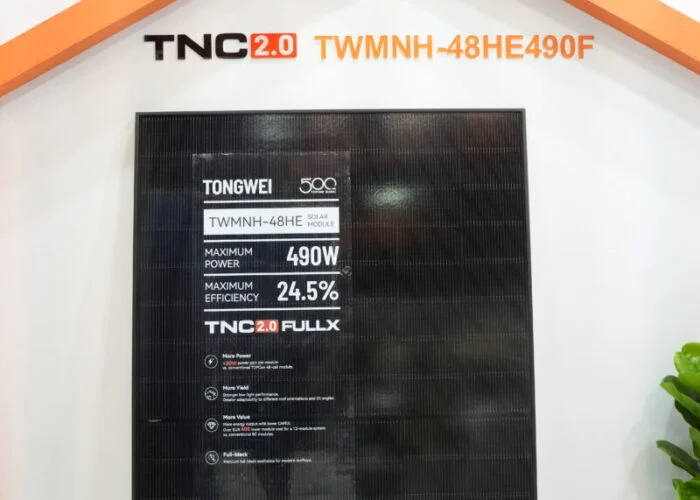
Tongwei, a dual leader in polysilicon and cells, expects a net loss attributable to shareholders of RMB4.8-5.4 billion (US$0.7-0.79 billion) for the first half of 2026. The company acknowledged that while outdated, low-efficiency capacity is gradually being phased out, the supply-demand mismatch across the chain remains unresolved. Sustained low prices for both upstream and downstream products continue to weigh heavily on margins.
Leading module manufacturers are facing mounting operational pressures. JA Solar projects a net loss attributable to parent shareholders of RMB2.4–2.9 billion for the first half of 2026. Its overseas operations have emerged as a major drag on earnings. The removal of export VAT rebates (subscription required) has added tax burdens, while escalating global trade barriers—compounded by geopolitical disruptions to cross-border logistics—have delayed overseas project deliveries and triggered contractual penalty claims. A confluence of external headwinds is eating into corporate earnings.
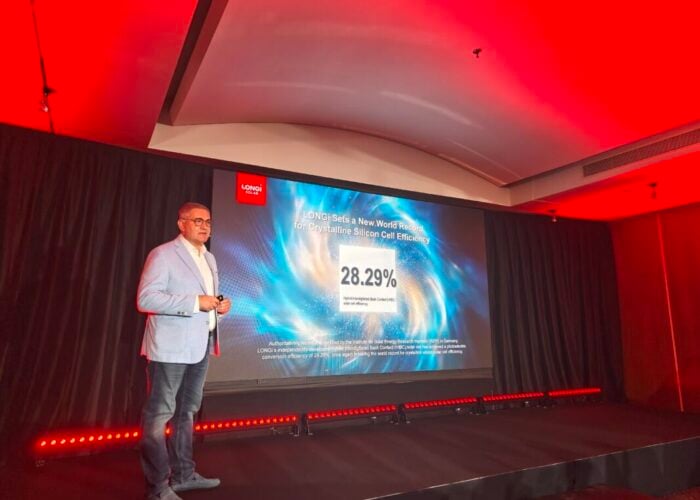
LONGi Green, a vertically integrated leader in wafers and modules, projects a net loss attributable to parent shareholders of RMB3.4–3.8 billion for H1 2026, with recurring net losses widening to RMB3.7–4.2 billion. The company attributed the deeper losses primarily to persistent supply-demand imbalances across the industry. Additional pressure came from limited grid absorption capacity for new renewable installations and last year’s pre-deadline installation rush—both of which drove a sharp decline in new domestic PV additions in the first half of 2026.
Compounding these challenges were slumping module sales, low operation rates, compressed gross margins, investment losses from associates, and foreign-exchange losses from RMB currency fluctuations, all of which collectively deepened the overall deficit.
The midstream cell segment and supporting PV glass sector have not been spared. Drinda New Energy Technology, an N-type cell manufacturer, expects an H1 2026 net loss of RMB180–270 million. Flat Group, a dominant PV glass player, is set to record its first loss since listing, with a projected deficit of RMB300–400 million—driven primarily by glass overcapacity and persistently declining prices, which have pushed the entire segment into the red.
Amid broad industry losses, structural divergence has grown more pronounced. Several top-tier players have narrowed their deficits through cost optimization, product upgrades, and overseas expansion, while a few niche sub-sectors have carved out independent upward growth trajectories.
TCL Zhonghuan shows clear improvement, forecasting a H1 loss of RMB3–3.3 billion, narrowing significantly year-on-year, with Q2 results sustaining a recovery from Q1. Its non-silicon wafer costs fell more than 13% year-on-year; shipments of high-efficiency BC and half-cut modules exceeded 15% of total output; and overseas module shipments quadrupled. Surging overseas revenue helped offset weak domestic demand, while scale efficiencies and an improved product mix together drove loss reduction.
Aiko, a frontrunner in BC cell production, also posts marginal improvement. Although the company still forecasts a net loss of RMB680–790 million for the first half, its quarterly losses have narrowed considerably, and the impact of short-term headwinds—such as export tax rebate adjustments and exchange-rate volatility—is gradually being absorbed.
Trina Solar has likewise shown signs of earnings recovery. Its H1 forecast projects a net loss attributable to shareholders of RMB180-360 million, narrowing sharply by 88%–94% year-on-year from the RMB2.92 billion loss recorded in the same period last year.
On a quarterly basis, Trina Solar is expected to post a Q2 net result ranging from a loss of RMB77 million to a profit of RMB103 million—a marked sequential improvement from a Q1 loss of RMB 283 million. The company could reach quarterly break-even as early as Q2 and currently ranks as the smallest loser among the world’s top five module vendors.
Trina Solar attributed the improvement to two key factors. On the module front, the company has stepped up its presence in high-value markets, with the proportion of high-quality module orders rising steadily. Meanwhile, its energy storage and decentralised PV system businesses have delivered strong profits for the group.
Amid the industry’s adjustment phase, differentiated auxiliary material segments have taken the lead in posting profit growth. First Applied Material, a leading PV encapsulation film supplier, emerged as a standout player. The company expects a net profit of RMB869 million in H1 2026, up 75.35% year-on-year. Rising PV resin feedstock prices lifted film selling prices, boosting earnings from its core PV business. Meanwhile, its new PCB dry-film photoresist business has scaled up, opening a second growth driver that helps offset the cyclical pressure on its PV manufacturing operations.
Technological and structural differentiation spur early recovery signals
High-efficiency BC back-contact technology has emerged as a key differentiator driving widening profit gaps among PV manufacturers.
LONGi Green posted a notable rise in the overseas share of its BC module sales in H1 2026. GCL-SI secured high-premium overseas orders by retrofitting existing lines for BC production. Equipment supplier DR Laser projects that new and revamped BC cell capacity will reach 40–50GW in 2026, with technology upgrades sustaining steady equipment demand.
Many institutional analysts note that high-power BC modules command consistent price premiums. Early movers in capacity conversion are likely to achieve quarterly profitability sooner, while also accelerating the elimination of outdated, low-efficiency capacity and helping rebalance industry supply-demand dynamics. Against a prolonged industry downturn, all major players have set out clear medium- to long-term operational strategies.
Drinda New Energy Technology expects the enforcement of mandatory national safety and energy-efficiency standards for PV modules to hasten the exit of low-end outdated capacity. As supply and demand rebalance, product pricing and margins are projected to stabilise and recover.
Leading PV manufacturers such as Tongwei and JA Solar are adopting a dual strategy: driving cost reduction and efficiency improvement while expanding their global footprint. By diversifying market exposure, they aim to mitigate trade frictions and geopolitical risks, effectively buffering against industry cyclical volatility.
Meanwhile, TCL Zhonghuan and Flat Group are continuously channeling investment into high-efficiency BC capacity upgrades, building competitive advantages through product differentiation.