The US’ fleet of solar and wind generation capacity is set to almost triple over the next decade, but even this is not enough to meet President Biden’s ambitious decarbonisation targets.
That’s according to a new report from market analyst BloombergNEF, which claims that the US’ renewables market’s current growth trajectory “will not be enough” to decarbonise the country’s power sector by 2035.
Try Premium for just $1
- Full premium access for the first month at only $1
- Converts to an annual rate after 30 days unless cancelled
- Cancel anytime during the trial period
Premium Benefits
- Expert industry analysis and interviews
- Digital access to PV Tech Power journal
- Exclusive event discounts
Or get the full Premium subscription right away
Or continue reading this article for free
This is despite the analyst’s prediction that 287GW of solar and 115GW of wind capacity will be added to the US’ grid over the next 10 years, with 25GW of solar tipped for “record growth” over the next four years.
“If the US is to achieve a carbon free grid by 2035 then it would need to at the very least add around 70GW of wind and solar a year from 2025 onwards,” said Tom Rowland Rees, head of North America research at BNEF. The current forecast, he said, sees just 43GW being added annually per year after 2025.
Biden’s progress so far
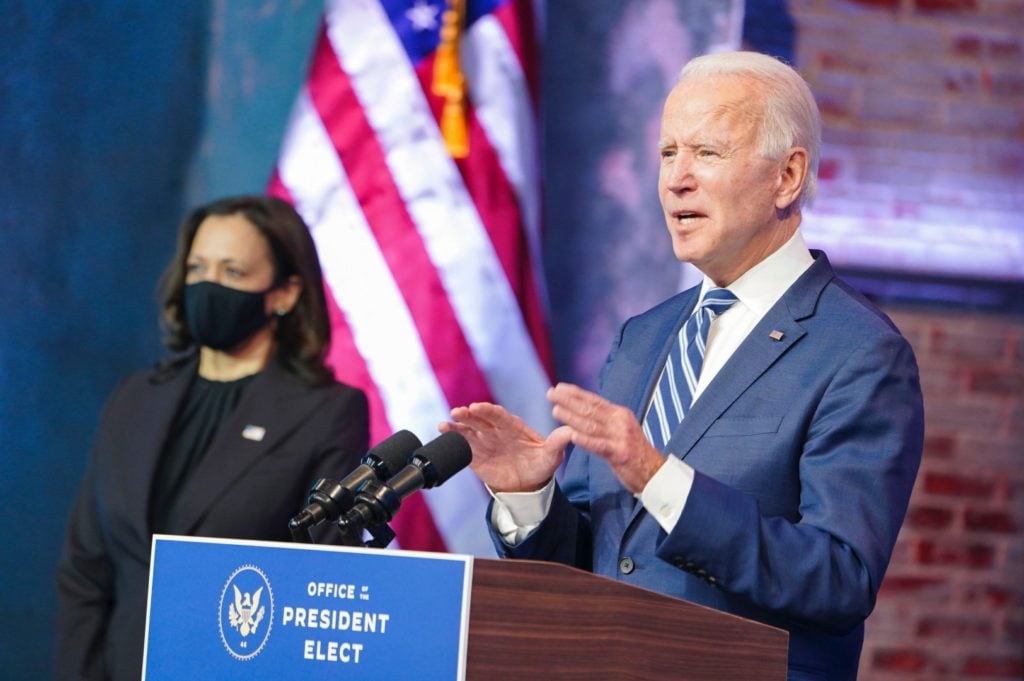
The report comes as Biden has brought in a raft of new measures this year in a bid to advance the nation’s renewable power capacity and fast-track the transition away from fossil fuels. The President set a target to reach carbon-free electricity generation by 2035, and spent his first weeks in office signing executive orders designed to encourage federal agencies to adopt low-carbon electricity and electric vehicles, and curtail the deployment of oil and gas power facilities. Last week, he unveiled a US$2 trillion American Jobs Plan that included several fiscal benefits for solar and storage developers, such as 10-year extensions to existing investment tax credits for both clean power generation and energy storage, and incentives to develop at least 20GW of high voltage power lines to upgrade the grid.
The Department of Energy also announced a US$128 million research and development funding package last month that it hopes will bring the cost of generating solar power down by 60% by the end of the decade. What’s more, the US Department of Treasury revealed this week that the new renewable tax incentives would be paid for by scrapping the subsidies oil and gas companies currently benefit from.
The outlook
While solar was tipped for significant growth, BNEF’s report noted that onshore wind is on track to be “the big winner” of Biden’s clean energy transition plans, with the sector seeing its own investment tax credits and the White House appearing “committed to resolving longstanding bottlenecks to deployment”.
Even without the additional boost from the American Jobs Plan, wind and solar instalments would grow by 287GW and 115GW respectively, said Tara Narayanan, BNEF’s lead solar analyst, while solar power “in particular” has been tipped for “record growth” until 2025.
According to BNEF’s 1H 2021 US Renewable Energy Market Outlook, Biden’s tax credit extensions will lead to “five years of record growth” in large-scale solar capacity additions at a rate of 20GW per year. Customer-sited solar will also “maintain its pace”, the group said, with 8GW a year coming online until 2025. California is set to lead the way in solar capacity additions, with over a third of new installations being built in the state.
But Rees said there is “still a significant gap” between the Biden Administration’s targets and what the analyst believes can be achieved in the current climate.
Political hurdles
Rees highlighted the brief mention of a so-called ‘clean energy standard’ when Biden unveiled the US$2 trillion infrastructure investment plan. The standard, intended to cut electricity bills and carbon emissions relating to power generation, is set to be pursued through legislature rather than executive authority, when Rees warned could result in a stalemate in Congress.
If voted through, Rees said, a clean energy standard may be able to “close the gap” between Biden’s decarbonisation targets and what the renewables sector can realistically achieve, but such a policy “is likely to prove contentious politically” and may face legal objections from states and utilities reliant on fossil-fuel power generation.
“Tax credits certainly help the renewables sector grow, but a Clean Energy Standard is the hill on which the battle to fully decarbonize the US power sector could be won or lost,” he said.