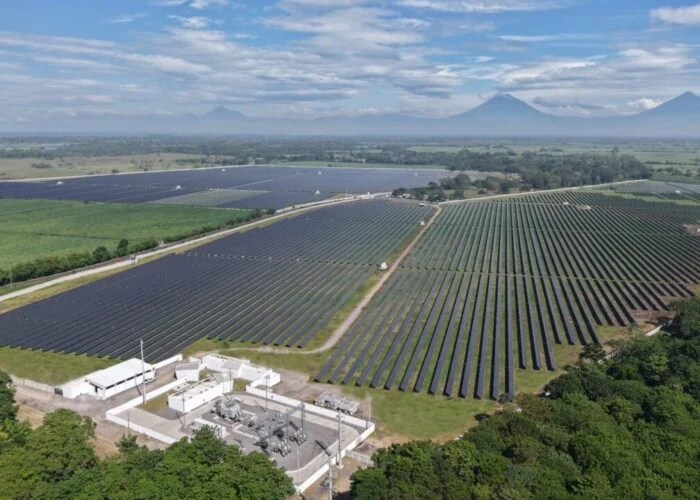
The US Treasury’s interim FEOC guidance has outlined “Material Assistance” provisions, which rely heavily on existing safe harbour calculations.
The guidance is “in line with expectations and doesn’t create any unanticipated obstacles”, according to Mike Hall of US renewables supply and analytics firm Anza Renewables.
Try Premium for just $1
- Full premium access for the first month at only $1
- Converts to an annual rate after 30 days unless cancelled
- Cancel anytime during the trial period
Premium Benefits
- Expert industry analysis and interviews
- Digital access to PV Tech Power journal
- Exclusive event discounts
Or get the full Premium subscription right away
Or continue reading this article for free
The guidance, released yesterday (12 February) by the Treasury, clarifies some of the provisions relating to FEOC that were expanded under the One, Big, Beautiful Bill Act (OBBBA) last summer. FEOC provisions limit the ability of companies to access US clean energy tax credits if they have certain corporate, financial or technical ties to Chinese firms.
The new guidance primarily outlines “Material Assistance” safe harbour provisions. The Treasury has said that project developers or manufacturers can use the existing domestic content safe harbour tables to calculate FEOC Material Assistance costs, as the new rules will be “substantially similar” to the provisions for domestic content introduced under the Inflation Reduction Act (IRA).
Material assistance safe harbour means the proportion of FEOC-exposed components and products that are permitted in US clean energy production and manufacturing projects seeking access to tax credits. The provisions are calculated based on the cost of products and components, with thresholds rising as time goes on.
Relying on the existing safe harbour tables may be the most significant revelation in the guidance. It means that the supply chain requirements on US companies are less onerous than they could have been, as the table for domestic content only includes solar modules, cells and other module assembly components like glass and frames, inverters and other plant components like trackers. Crucially, it does not account for the cost of solar wafers, ingots or polysilicon.
“The safe harbour allows taxpayers to trace to the level of detail of the items listed in the IRS’s domestic content safe harbour tables with additional averaging rules to account for the business realities of procurement and tracing,” US clean energy tax credit financing firm Crux said in a blog. “These rules are in contrast to an impractical framework of tracing subcomponents or raw materials to each individual facility-eligible component.
For project deployments seeking the investment tax credit (ITC) or production tax credit (PTC), Crux said: “This is material compliance relief that obviates the need for deeper upstream tracing, and the tables outline a discrete list of components to be considered.”
For solar manufacturers seeking access to the 45X Advanced Manufacturing Credit, Crux said the guidance “indicates that taxpayers must generally evaluate only the costs from their direct suppliers or own production of constituent materials.” It added that manufacturers “only need to evaluate the specific [components] that appear in the safe harbour table that corresponds to that [component].”
“We’re still digesting the guidance, but our initial read is that this is in line with expectations and doesn’t create any unanticipated obstacles to FEOC compliance,” said Hall. “The interim safe harbour rules look like they provide an actionable pathway for project owners to qualify for the ITC.
“It’s important to remember that these guidelines don’t apply to projects that were safe harboured before January 1, 2026. We believe multiple years’ worth of PV and BESS projects were safe harboured in 2025 and don’t have a FEOC compliance burden.”
Unanswered questions
The Treasury said it expects to release more guidance, regulations and safe harbour tables in the future, and questions are still unanswered over some elements of FEOC restrictions.
The OBBBA introduced “effective control” measures where companies could be designated a “Foreign-influenced entity” if they confer control of part of their operation to a “Specified Foreign Entity”. This control can take the form of contract agreements, influence over certain timelines or operations and even intellectual property (IP) licensing agreements.
The new guidance did add some more clarity to the definition of “effective control”, as Crux explains: “The notice highlights that this definition would include licensing agreements for the provision of intellectual property with respect to a qualified facility that was entered into or modified on or after July 4, 2025. This is an important clarification that licensing agreements entered into after this date qualify as effective control even if they do not also meet one of the other prohibited provisions”.
Even before the guidance, the spectre of FEOC restrictions had caused shifts in the US solar industry. A survey from Crux in December found that US solar companies were not waiting for guidance before assessing their procurement and compliance with expected FEOC rules. There have also been discussions about developers and buyers choosing to ignore FEOC and sacrifice the tax credits in favour of faster, cheaper and more available products that infringe on the guidelines.
On the manufacturing side, we have also seen a number of ownership changes that are likely tied to FEOC and the Trump administrations broader protectionist stance. Chinese solar manufacturers Trina Solar and JA Solar have both sold module production facilities to US-based companies, and multinational manufacturer Canadian Solar restructured its manufacturing business to take direct ownership of its US assets from its Canada headquarters, reducing exposure to its manufacturing subsidiary, CSI Solar, which is listed on the Shanghai stock exchange.
Most recently, Vietnam-based manufacturer Boviet Solar announced that it is committed to US solar manufacturing despite reports that its Chinese parent company is considering selling the firm.
You can read Crux’s FEOC guidance blog here.
After five editions of Large Scale Solar USA, the event becomes SolarPLUS USA to mirror where the market is heading. The 2026 edition, held in Dallas, Texas, on 24-25 March, will bring together developers, investors and utilities to discuss managing hybrid assets, multi-state pipelines, power demand increase from data centres and AI as well as the co-location of solar PV with energy storage in a complex grid. For more details and how to attend the event, visit the website here.