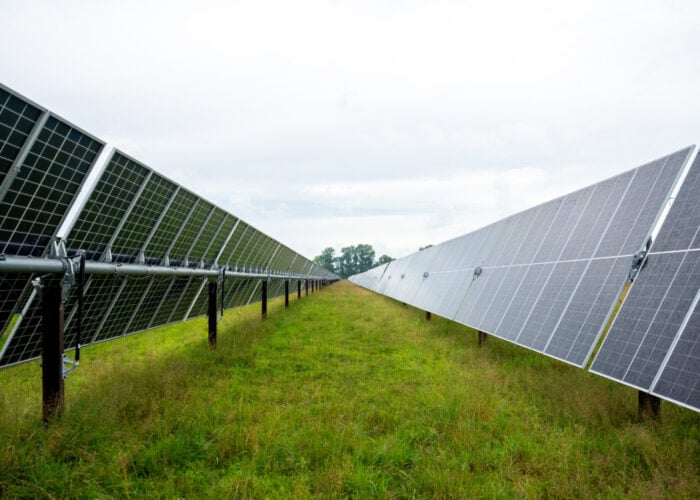
US-based solar module manufacturer Bila Solar will include US-made steel module frames in its 550W dual-glass products.
Bila signed a deal with Origami Solar to offer steel frames as an option for its dual-glass modules. The company said steel offers a “significantly stronger alternative” to the industry standard aluminium frame and would improve tax credit eligibility and supply security for its customers.
Try Premium for just $1
- Full premium access for the first month at only $1
- Converts to an annual rate after 30 days unless cancelled
- Cancel anytime during the trial period
Premium Benefits
- Expert industry analysis and interviews
- Digital access to PV Tech Power journal
- Exclusive event discounts
Or get the full Premium subscription right away
Or continue reading this article for free
Delivery of the new modules is expected to begin in the second quarter of 2026. Bila Solar originally planned to produce glassless, flexible modules, but changed course to traditional stiff panels.
In its announcement, Bila Solar said: “In the wake of rising import prices, up 0.4% in July alone, and the rapid reshuffling of global solar supply chains, these new modules deliver the financial stability projects need”. It added that domestic steel offered security and price benefits over imported aluminium products.
In February, president Trump announced a flat 25% tariff on all steel and aluminium imports to the US, which he doubled in June to 50%.
Origami produces its steel frames at an Arkansas facility owned by US steel manufacturer Priefert Steel. It began production in February, just days after the steel import tariff was announced.
Solar supply security
Origami has made a lot of the supply certainty it claims that its steel module frames can give to buyers. As policy has turned against US solar manufacturers and the future looks more uncertain, supply certainty has taken on new importance.
Origami has already inked frame supply deals with module manufacturers Solx and Heliene for US-made products, in addition to the new deal with Bila.
Mick McDaniel, vice president and general manager of Bila Solar, said: “By integrating Origami’s innovative and remarkably stronger steel frames and pairing them with US-manufactured solar cells, we not only offer a stronger, more reliable module but also provide customers with increased domestic content to facilitate access to the 10% domestic content bonus adder.”
The domestic content bonus has been an incentive for developers to buy US-made products, as it gives them a 10% tax credit on top of the 30% Investment or Production Tax Credit (ITC/PTC) available under the Inflation Reduction Act (IRA) of 2022.
However, last month the Trump administration announced an early end to the ITC and PTC, and the domestic content bonus will go with them. There will likely be a rush of projects and US supply deals signed between now and 4th July 2026, when solar projects must be under construction in order to access the credit and any domestic content bonus.
Beyond its deal with Origami, Bila Solar has inked a supply deal with South Carolina-based cell producer ES Foundry for its passivated emitter rear contact (PERC) cells.
The use of PERC for new solar module manufacturing is a growing trend in the US. While most of the global market – led by China – has moved onto tunnel oxide passivated contact (TOPCon) technology, which offers better performance and higher efficiency, a number of US producers have been producing PERC.
Suniva and ES Foundry are both producing PERC cells in the US. In an interview with PV Tech Premium, ES Foundry said that the intellectual property disputes over TOPCon made PERC a more attractive option in the current US market.
In a piece coming later this week, we speak with MJ Shiao, VP of supply chains and manufacturing at the American Clean Power Association, who said that PERC production could be a valuable lifeline for US solar manufacturers, as there are fewer IP hurdles to jump than with TOPCon.