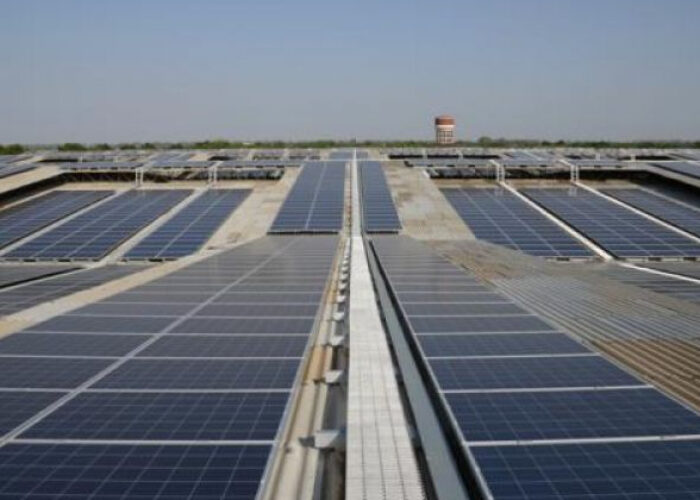
Solar cell and module manufacturer Canadian Solar has shipped 3.1GW of modules in the second quarter of 2026, a 60% year-on-year decrease.
The Q2 2026 shipment figure puts Canadian Solar’s module volumes in any Q2 at their lowest level since 2020, when the company shipped 2.9GW of modules in Q2 2020. As shown in the chart below, module shipments for the first half of 2026 are lower than Q1 2025 alone.
Try Premium for just $1
- Full premium access for the first month at only $1
- Converts to an annual rate after 30 days unless cancelled
- Cancel anytime during the trial period
Premium Benefits
- Expert industry analysis and interviews
- Digital access to PV Tech Power journal
- Exclusive event discounts
Or get the full Premium subscription right away
Or continue reading this article for free
However, on a quarterly basis, the shipments are up 25%, as the company continues to navigate a weaker solar market while expanding its US manufacturing footprint.
US solar manufacturing expansion
Looking ahead, Canadian Solar expects solar module shipments to increase to between 3.5GW and 3.8GW in Q3 2026, pointing to a sequential recovery in volumes after the sharp YoY decline in Q2. The expected increase in Q3 module shipments would still leave volumes below the 7.9GW recorded in Q2 2025.
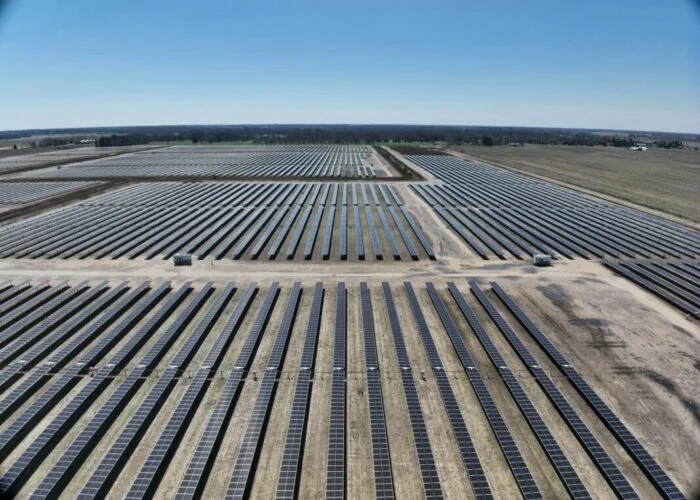
The company is simultaneously increasing its US manufacturing capacity, with its Texas module assembly plant expanding from 5GWp to 10GWp. The company expects this expansion to be completed in H2 2026, while its Jeffersonville, Indiana, HJT solar cell facility is being expanded to 6.3GWp. Phase I of the solar cell facility has a nameplate capacity of 2.1GWp and is the first commercial-scale HJT solar cell facility in the US.
Moreover, the company is installing and commissioning additional solar cell production lines through 2026 and increasing production capacity beyond 6GWp in response to customer demand.
Phase II is expected to begin trial production in the first quarter of 2027. The expansion will add 4.2GWp of solar cell annual nameplate capacity, bringing Canadian Solar’s total solar cell nameplate capacity in the US to 6.3GWp.
Colin Parkin, CEO of Canadian Solar, said: “We are executing on a multidimensional solar technology roadmap. In addition to ramping up the Phase I capacity of 2.1GWp, we will start installing equipment for Phase II before the end of the year, bringing total nameplate cell capacity to 6.3GWp in the first half of 2027. This will position CS PowerTech as the largest crystalline silicon cell manufacturer in North America. When combined with our 10GWp module facility in Texas, CS PowerTech solidifies its position as one of North America’s premier integrated PV manufacturers.”
“We delivered 3.1GW of solar modules, with nearly half shipped to our North American home base. In addition, we achieved 3.7GWh of energy storage shipments to internal and external projects under execution, serving utility-scale projects across North America, EMEA, Asia Pacific and Latin America. As we double down on our US manufacturing strategy, we continue to rebalance our global project development business and optimize capital allocation across our core growth engines,” Parkin added.
Canadian Solar has also launched its TOPCon 3.0 high-power-density module during Q2 2026, with power output of up to 670Wp and conversion efficiency of 24.8%, shipments are scheduled to begin in August 2026.
Revenue falls alongside solar shipment decline
Canadian Solar reported a 12% sequential increase in net revenues to US$1.2 billion for the second quarter of 2026, as higher solar module and battery energy storage sales offset lower project sales.
Net revenues were down 29% YoY, with the decline reflecting lower solar module and project sales.
Canadian Solar’s gross profit fell to US$168 million in Q2 2026, from US$271 million in Q1 2026. Operating expenses increased to US$240 million from US$198 million sequentially, reflecting higher ramp-up and logistics costs. However, operating expenses were down from US$378 million in Q2 2025, mainly because of lower impairment charges related to certain solar and storage assets and manufacturing assets.
The company reiterated its 2026 US guidance of 6.5GW to 7GW of solar modules and 4.5GWh to 5.5GWh of battery energy storage solutions. Recurrent Energy is also expected to close delayed project sales from Q2, supporting a sequentially stronger Q3.
Solar project pipeline stands at 21.7GWp
Canadian Solar’s Recurrent Energy business had a total solar project development pipeline of 21.7GWp as of June 30, 2026.
The pipeline included 1.7GWp under construction, 2.2GWp of backlog and 17.7GWp of projects in advanced and early-stage development.
By region, the pipeline comprised 5,650MWp in North America, 6,293MWp in Europe, the Middle East, and Africa (EMEA), 6,746MWp in Latin America and 2,978MWp in Asia Pacific. The figure includes 392MWp in backlog partially sold to third parties.
Recurrent Energy’s business model combines electricity revenue from its operating portfolio, asset sales and power services. Its O&M platform currently has 15GW of contracted projects.
Storage shipments surge
Battery energy storage was a significant growth area during the quarter.
Total battery energy storage shipments recognised as revenue reached 3.7GWh, up 82% QoQ and 73% YoY. Of this total, 471MWh was shipped to internal projects under execution, with the associated revenue to be recognised in subsequent quarters.
The company’s e-STORAGE business had a contracted backlog, including contracted long-term service agreements, of US$3.5 billion as of June 30, 2026. Canadian Solar also reported an 84.1GWh battery energy storage project development pipeline at the end of the quarter, including 600MWh under construction, 4.4GWh in backlog and 79.1GWh in advanced and early-stage development.
Learn more about how the domestic solar supply chain is developing in the United States at our PV CellTech USA conference in San Francisco on 13-14 October. For full details and booking, click here.