Thin-film solar manufacturing could add over US$10 billion in product value to the US economy by 2026, according to a study commissioned by US thin-film cadmium telluride (CdTe) solar manufacturer First Solar.
The study, conducted by the Kathleen Babineaux Blanco Public Policy Center at the University of Louisiana at Lafayette – and commissioned by First Solar – found that First Solar’s plans for 14GW of domestic US module production in 2026 would add an “estimated” US$4.99 billion to the value of the US economy and US$10.18 billion in “output”, the value of products produced by the economy per year.
Try Premium for just $1
- Full premium access for the first month at only $1
- Converts to an annual rate after 30 days unless cancelled
- Cancel anytime during the trial period
Premium Benefits
- Expert industry analysis and interviews
- Digital access to PV Tech Power journal
- Exclusive event discounts
Or get the full Premium subscription right away
Or continue reading this article for free
This is in addition to around US$2.78 billion in labour incomes from around 30,000 direct, indirect and induced jobs, which the report estimated would result from First Solar’s operations by 2026.
Retrospective figures from 2023 found that First Solar’s 6GW of nameplate US module production capacity added US$2.75 billion in value and US$5.32 billion in output to the US economy. Moreover, its construction activity at facilities in Ohio, Alabama and Louisiana contributed over US$900 million in economic value and almost US$2 billion in output.
The study used IMPLAN economic software to analyse First Solar’s actual and forecast spending. No such studies have been published for other solar manufacturers.
Thin-film vs silicon
“This report reflects the real value of solar technology made in America for America, with materials sourced from businesses across the country, and not simply assembled here using imported components,” said Mark Widmar, chief executive officer of First Solar.
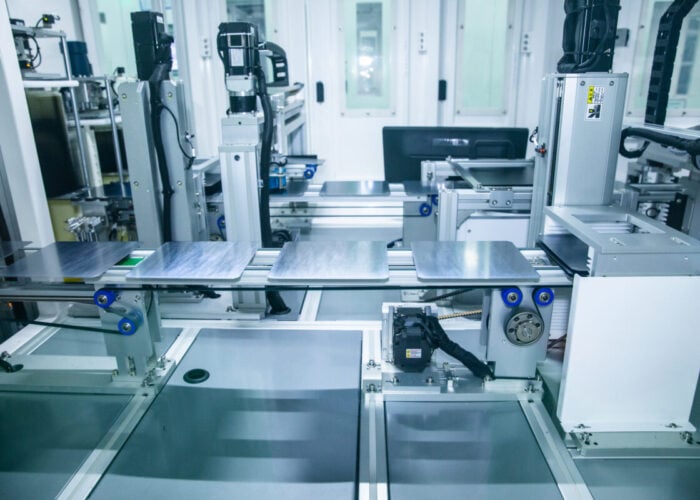
Widmar’s comments are true by virtue of First Solar’s technology choice. As a thin-film CdTe manufacturer, First Solar’s manufacturing process relies on fewer steps than traditional PV technologies and is isolated from the global silicon supply chain that dictates other major manufacturers’ operations.
For example, First Solar’s process “integrates the manufacturing of wafers and cells”, the company said in a statement, and can be vertically integrated in the US market much more easily than silicon competitors, for whom the supply chain is overwhelmingly concentrated in China and Southeast Asia.
CdTe modules can also benefit more easily from the government’s tax credits under the Inflation Reduction Act (IRA), most notably the domestic content adder, which requires 40% of a solar module’s cost of materials to come from US-made components.
For silicon-based competitors, upstream capacity in the US is still coming online and faces incredible competition from producers in Southeast Asia. US renewables firm Clean Energy Associates wrote a guest piece for this publication in December on the disparities between US capacity announcements for modules and more upstream components.
Is 2024 First Solar’s year?
Technology notwithstanding, PV Tech head of research Finlay Colville has predicted that First Solar could be the only major global solar manufacturer to have a profitable 2024.
In a blog post published in November 2023, Colville drew attention to both First Solar’s insulation from the silicon supply chain – which he forecast to have a difficult year – and First Solar’s projected capital expenditure (capex) for 2024, which could hit record levels, as reasons for optimism for the company.
First Solar’s capex could also outstrip the cumulative capex for the top four Chinese solar manufacturers: JinkoSolar, JA Solar, Canadian Solar and Trina Solar. Much of this expenditure is due to the capacity expansions in Alabama and Louisiana and First Solar’s new research and development (R&D) centre in Perrysburg, Ohio.