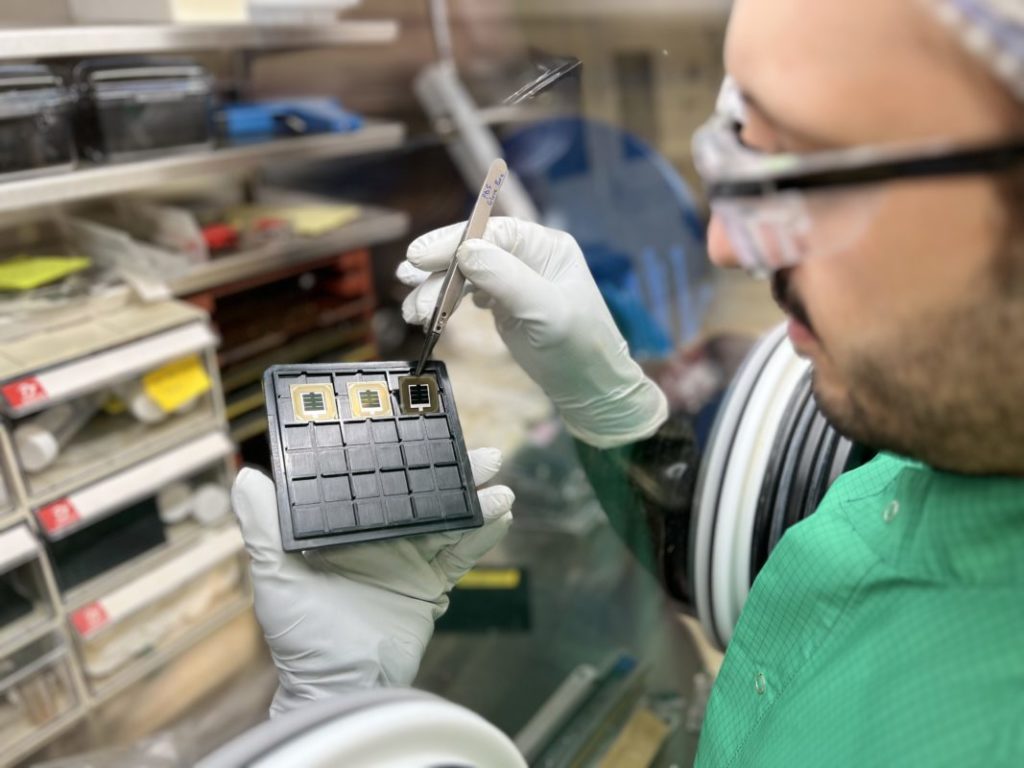
Italian PV manufacturer FuturaSun has acquired a research and development startup, Solertix, which focuses on perovskite cell technology research.
Solertix began at the University of Rome in its Organic Solar Center (CHOSE) which focuses on third-generation PV cell research. FuturaSun said that it plans to double the workforce at the startup, with a view to developing a stable, commercially viable perovskite product. The price of the purchase has not been revealed.
Try Premium for just $1
- Full premium access for the first month at only $1
- Converts to an annual rate after 30 days unless cancelled
- Cancel anytime during the trial period
Premium Benefits
- Expert industry analysis and interviews
- Digital access to PV Tech Power journal
- Exclusive event discounts
Or get the full Premium subscription right away
Or continue reading this article for free
“Perovskite is the future of high-efficiency photovoltaics,” said Alessandro Barin, CEO of FuturaSun, adding: “and in this specific R&D segment, we couldn’t afford not to be key players, working alongside those who are dedicated to scientific research at the highest academic levels.”
Tandem perovskite cells are a hot topic in the solar PV industry, spoken about by research institutes and companies as the ‘future’ of PV cells. In lab conditions, perovskites have been shown to offer notably higher efficiencies than silicon-based cells. UK-based researchers Oxford PV claimed a new 28.6% world record efficiency for a commercial size cell last week, and Korean-owned solar manufacturer Qcells recently announced a US$100 million investment into a pilot perovskite production plant.
In terms of non-commercial sized cells, the efficiency level is currently held by a Saudi Arabian university team, with 33.2% efficiency.
FuturaSun said that perovskite holds potential benefits for both R&D and industrial production. Alongside the increased efficiencies – which are due to the material being able to absorb a wider range of the light spectrum – it is also relatively simple to synthesise and can be produced through a printing method which can cut industrial costs.
However, the material is very unstable and has yet to be effectively produced at an industrial scale. Perovskite has a tendency to degrade rapidly when exposed to the elements.
The company has recently announced manufacturing capacity expansions in Europe and China. Last month, it unveiled plans for a 10GW solar cell plant in the city of Huai’an, China, representing US$163 million in investment. In March it also announced plans for a 2GW module factory in Cittadella, Italy.