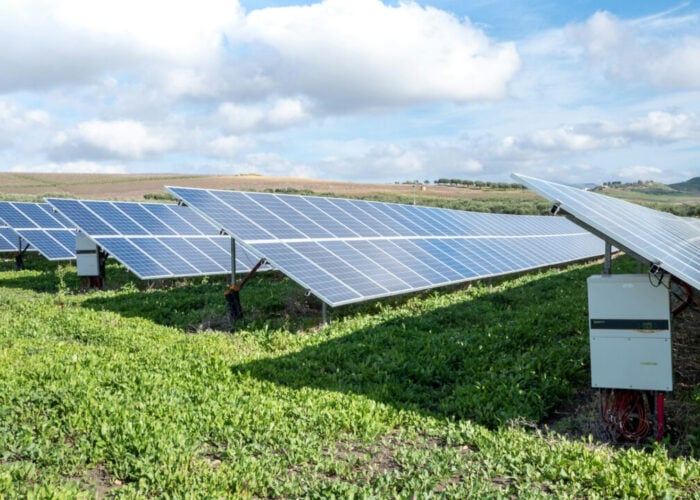
Attracting private investments into the Polish solar sector, and effectively integrating EU funding and private finance into the sector, will be essential if Poland is to meet its renewable power goals.
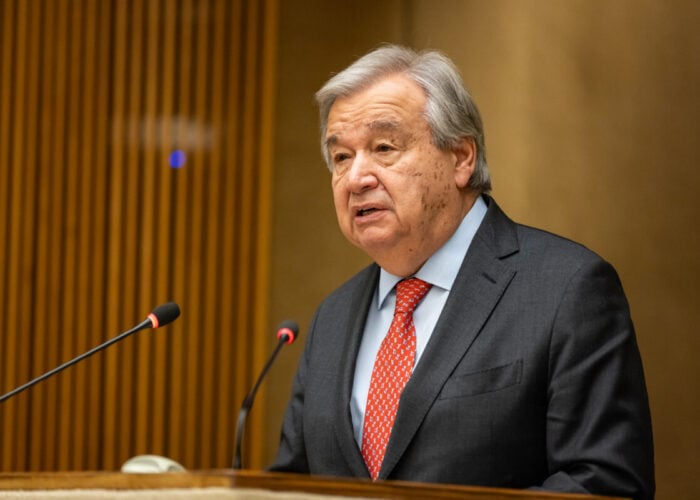
This was the opinion of Dr Konrad Wojnarowski, undersecretary of state at the Polish Ministry of Development Funds and Regional Policy, who opened Solar Media’s Large Scale Solar Central Eastern Europe event at the Warsaw Presidential Hotel this morning in the Polish capital. Wojnarowski called the need to expand the Polish solar sector as “the greatest investment need in Europe,” highlighting the vital role that securing finance will play in the country’s long-term energy future.
Try Premium for just $1
- Full premium access for the first month at only $1
- Converts to an annual rate after 30 days unless cancelled
- Cancel anytime during the trial period
Premium Benefits
- Expert industry analysis and interviews
- Digital access to PV Tech Power journal
- Exclusive event discounts
Or get the full Premium subscription right away
Or continue reading this article for free
“September 2024 turned out to be a breakthrough for renewable energy sources in Poland,” said Wojnarowski. “For the first time in history, production electricity from coal fell below 50%, while the position of renewable energy sources was strengthening.
“The key development challenge is to provide the economy, institutions and citizens with optimal and adaptable energy supplies, at an economically acceptable price,” he continued. “Renewable energy sources in October 2024 provided over 30% of electricity demand; the Ministry of Development Funds and Regional Policy supports the energy transformation by directing EU funds to support the energy transition.
Wojnarowski pointed to a number of supportive EU policies, such as the Recovery and Resilience Facility (RRF), a massive €650 billion (US$683 billion) investment to help make the economies of European countries more sustainable and resilient in the wake of Russia’s invasion of Ukraine and the following energy crisis. The RRF combines both grant and loan finance, and Poland expects to benefit from €23 billion in RRF loans, alongside €7 billion in grants.
However, Wojnarowski noted that securing private investment will be vital if the Polish solar sector is to continue its growth. Earlier this year, figures from Bloomberg New Energy Finance (BNEF) noted that the world will need around US$1 trillion of investment into renewable power per year to meet its 2030 renewable power addition goals, but that solar was one of the most financially viable technologies, considering the low levelised cost of electricity (LCOE) in solar.
“It is not strictly about investments in renewable energy sources, but the use of a wider industry to stimulate the economy, including the development of, for example, new PV technologies [so we can] compete with China,” said Wojnarowski, whose comments follow the EU Commission’s approval of a €1.2 billion Polish renewable power manufacturing scheme, and discussions PV Tech Premium has had with European solar manufacturers Holosolis and Carbon in the last year.

‘Storage plays a key role’
Wojnarowski’s introduction followed comments made by Barbara Adamska, president of the Polish Energy Storage Association, who pointed out that, despite the historic strength of wind in the Polish renewable power sector, solar has seen exponential growth in recent years, with around 20GW of installed PV capacity currently in operation.
“Large-scale solar is a significant part of this growth, with over 80 projects, amounting to 9GW, aiming to connect to the Polish transmission grid,” said Adamska, who noted that there is a further 19GW of solar capacity “ready for implementation”, compared to less than 2GW of new wind capacity.
Adamska also noted that one-quarter of this 19GW pipeline of solar capacity is set to feature co-located battery energy storage systems (BESS), an important development for the long-term energy security of Poland.
“This shows not only how quickly PV is growing in Poland, but how much focus there is on integrating energy storage into new projects,” said Adamska. “Storage plays a key role in balancing supply and demand, keeping the grid stable and ensuring solar power is efficient and reliable.”
The government has set ambitious targets for its renewable power sector, with the Energy Policy of Poland, adopted in 2021, aiming to double the country’s operating renewable energy capacity by 2030. Under the latest National Energy and Climate Plan (NECP), renewable power will account for a greater proportion of the country’s energy mix than lignite and hard coal by 2040, with these technologies set to account for 40% and 28% of domestic electricity generation.
PV Tech publisher Solar Media is organising the fourth edition of Large Scale Solar Central and Eastern Europe in Warsaw, Poland 26-27 November 2024. The event focuses on Eastern Europe with a packed programme of panels from industry leaders responsible for the build out of solar and storage projects in Poland, Bulgaria, Romania, Hungary and the Baltics. For more information visit the event website.