Stronger downstream demand drove a surge in wafer prices last week, according to the latest figures from the Silicon Industry Branch of the China Nonferrous Metals Industry Association.
The body’s latest wafer price quotes, released on 21 August, showed the average transaction price for n-type G10L monocrystalline wafers (182×183.75mm, 130μm) at RMB1.12 (US$0.16) per piece, a sharp 40% week-on-week increase.
Try Premium for just $1
- Full premium access for the first month at only $1
- Converts to an annual rate after 30 days unless cancelled
- Cancel anytime during the trial period
Premium Benefits
- Expert industry analysis and interviews
- Digital access to PV Tech Power journal
- Exclusive event discounts
Or get the full Premium subscription right away
Or continue reading this article for free
The average transaction price for n-type G12R monocrystalline wafers (182×210mm, 130μm) came in at RMB 1.14 per piece, up 26.67% from the previous week.
The average transaction price for n-type G12 monocrystalline wafers (210×210 mm, 130μm) stood at RMB 1.22 per piece, up 10.91% week on week.
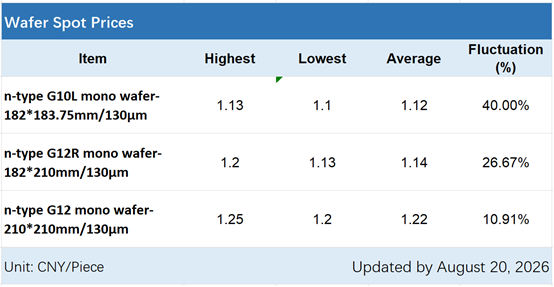
The prices are derived from a weighted average based on the quarterly output shares of 12 companies for p-type M10, n-type G10L, n-type G12R, p-type G12, and n-type G12 monocrystalline wafers. The output of these 12 companies participating in the price statistics accounted for 94.1% of China’s total domestic monocrystalline wafer production in Q2 2026. All prices are tax-inclusive, and fluctuations are calculated by comparing them with prices of the previous week.
The Silicon Industry Branch noted that stronger downstream demand was the primary driver behind the steep climb in wafer prices. Specifically, while domestic end-user demand remained moderate, overseas solar cell manufacturers accelerated their wafer purchases within the policy window to hedge against risks from US Section 232 measures. Meanwhile, India entered its traditional peak installation season, driving a surge in wafer export orders.
Rising demand led to near-term supply tightness and pushed wafer prices higher. In addition, 183mm wafers are predominantly exported, whereas 210R and 210N wafers are mostly destined for the domestic market— explaining the larger price gains seen in 183mm wafers.
The Silicon Industry Branch further noted that the current round of price hikes is primarily driven by growing overseas demand, and robust export activity is expected to continue. Meanwhile, rising upstream polysilicon quotes are providing additional cost support. Accordingly, the wafer market is projected to maintain steady upward momentum.
According to InfoLink’s weekly price update, the polysilicon market has broken out of its previous pricing stalemate, with several suppliers issuing new quotes. Dense re-feed polysilicon is quoted near RMB43/kg and granular polysilicon at RMB40-41/kg, both well above prior levels. Trading activity in dense re-feed material remained light throughout the week of 21 August, supported mainly by buying from distributors and arbitrage traders. The RMB43/kg producer quote has yet to become the prevailing traded price.
Cell and module prices also moved higher. Mainstream cell prices hit RMB0.33-0.35/W (+23.64% WoW), largely underpinned by overseas demand, with 183N and 210RN shipments taking a large share, while 210N demand remained mostly domestic.
Module prices posted a mild weekly gain, with mainstream prices at RMB0.69–0.71/W (+1.45% WoW).