Queensland Investment Corporation (QIC), one of Australia’s largest infrastructure fund managers, has completed an AU$2 billion (US$1.29 billion) refinancing and equity raise for Pacific Energy, a distributed energy company.
Specifically, Pacific Energy’s debt facility has increased by AU$400 million, bringing the overall capacity to AU$1.6 billion, while QIC has raised an additional AU$370 million in equity.
Try Premium for just $1
- Full premium access for the first month at only $1
- Converts to an annual rate after 30 days unless cancelled
- Cancel anytime during the trial period
Premium Benefits
- Expert industry analysis and interviews
- Digital access to PV Tech Power journal
- Exclusive event discounts
Or get the full Premium subscription right away
Or continue reading this article for free
According to Pacific Energy, the new funding will fuel its growth prospects across Australia.
Seven new lenders have joined the existing syndicate of banks, forming a lending group of 15 institutions.
The new lenders are Société Générale, ANZ, Export Finance Australia, DNB Bank, China Construction Bank, Bank of Communications, and DBS.
They join the following banks already in the syndicate: Westpac Banking Corporation, National Australia Bank, Industrial and Commercial Bank of China, Canadian Imperial Bank of Commerce, Sumitomo Mitsui Banking Corporation, Mizuho, Oversea-Chinese Banking Corporation and Bank of China.
Jamie Cullen, CEO of Pacific Energy, said the debt upsizing represents a “significant milestone” in supporting the company’s strategic growth ambitions.
“This boost to our growth capital puts us in a strong position to advance our robust pipeline of renewable energy projects and take full advantage of the increasing opportunities in Australia’s transition to a low-carbon economy,” said Cullen.
“We’re in a leading position to deliver long-term value for our customers, and at the same time, move the dial in a meaningful way towards a more sustainable future.”
According to Pacific Energy, the refinancing has been achieved on “more competitive terms”, including a reduced funding cost and extended debt maturities with diversified tenors of five, seven and 10 years. This provides more financial flexibility and reduced risk.
A total of AU$550 million from the syndicated facilities has been allocated to green loan tranches, which underscores the company’s dedication to decarbonisation and sustainable investment initiatives.
In addition to further diversifying its lending options, Pacific Energy will introduce an Asian Term Loan (ATL) to support its long-term capital strategy.
Pacific Energy’s focus on hybridised solar PV assets
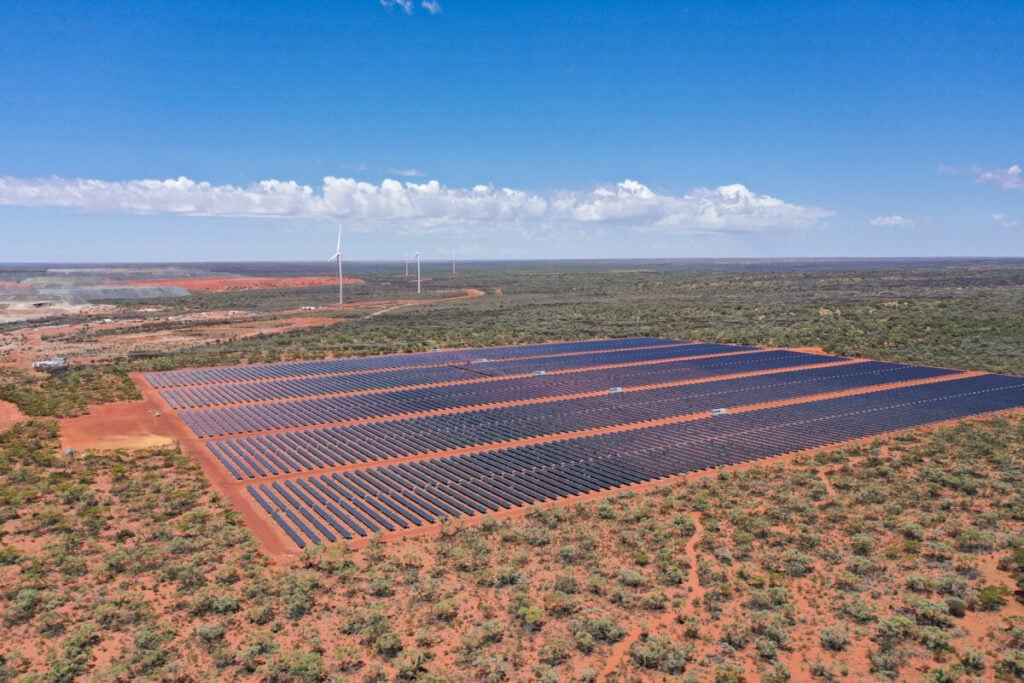
The organisation has utilised hybridised renewable energy generation assets, specifically solar-plus-storage, in the country. Indeed, the group recently completed a 61MW project in Western Australia to power a gold mining operation.
Last year, Pacific Energy penned a deal with mining company Gold Fields to deliver a 35MW solar PV power plant at the St Ives mine site, located around 80km south of Kalgoorlie in Western Australia’s Eastern Goldfields region.
The company also secured a 20-year power purchase agreement with Horizon Power, Western Australia’s energy provider, that would see Exmouth run on 80% solar PV-derived renewable energy in the Gascoyne region.
As part of this project, a new hybrid system comprising a 9.6MW solar PV power plant, a 49.6MWh battery energy storage system and a 7MW gas power station would be developed.