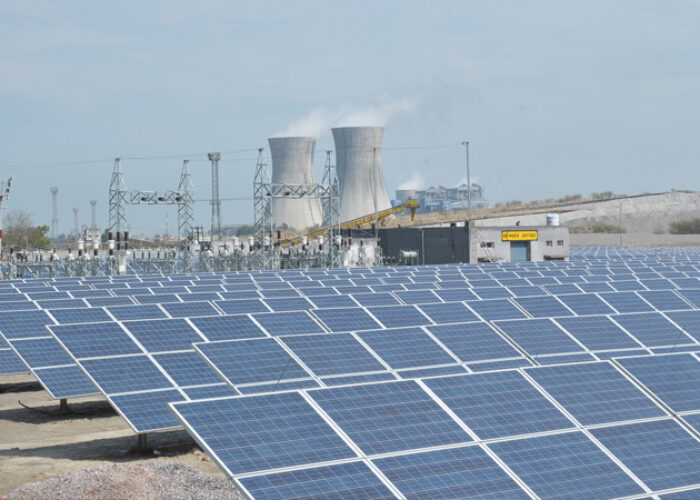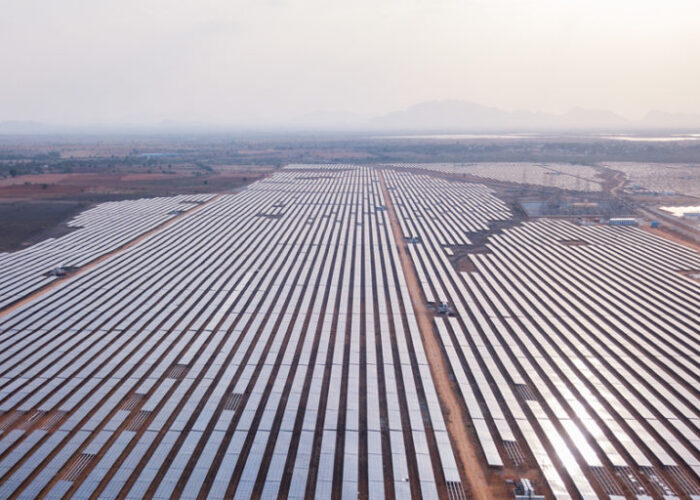
Indian state-owned renewable energy developer SJVN has commissioned a 1GW solar PV plant in Rajasthan, India, its largest solar project to comply with India’s domestic content requirement (DCR) rules.
The project consists of solar installations at two sites, Bandarwala and Karnisar Bhatiyan, both in Rajasthan, and uses both cells and bifacial solar modules produced by Indian manufacturer TP Solar Limited, a subsidiary of Indian energy giant Tata Power.
Try Premium for just $1
- Full premium access for the first month at only $1
- Converts to an annual rate after 30 days unless cancelled
- Cancel anytime during the trial period
Premium Benefits
- Expert industry analysis and interviews
- Digital access to PV Tech Power journal
- Exclusive event discounts
Or get the full Premium subscription right away
Or continue reading this article for free
Another Tata Power subsidiary, Tata Power Renewable Energy Limited (TPREL), completed engineering, procurement and construction (EPC) work at the project, and the two organisations collaborated on the launch of a 300MW solar project, which was also compliant with DCR regulations, last November.
The news is an encouraging development for the Indian solar sector, which has seen the government seek to significantly expand the contributions of domestically-produced components. Last August, energy minister Pralhad Joshi announced that Indian module manufacturing capacity had increased from 2.3GW in 2014 to over 100GW in 2025, driven by the implementation of the Approved List of Models and Manufacturers, a list of largely Indian-based manufacturers whose solar products are eligible for use on government-supported projects.
Then, last September, the government added 4.8GW of cell manufacturing capacity to the ALMM list, in order to incentivise more cell manufacturing in India.
Offtake agreements in place
TPREL also announced three offtake agreements, covering the entirety of the project’s capacity: 500MW will be allocated to Rajasthan Urja Vikas and IT Services Limited (RUVITL), 300MW to Jammu & Kashmir Power Limited (JKPL) and 200MW to Uttarakhand Power Corporation Limited (UPCL). The commissioning of the project brings TPREL’s total operational utility-scale renewable energy capacity to 11.6GW, with the company providing third-party EPC services at 4.9GW of this capacity.
The news follows a number of project announcements from SJVN, which include battery energy storage system (BESS) components. Last November, the company awarded Indian developer ACME Solar a contract for a 300MW solar project, to be paired with 1,800MWh of BESS; earlier in 2025, it awarded a contract for another solar-plus-storage, of the same solar capacity, to Singapore-based engineering firm Sembcorp.
A report from Mercom India found that, in the first half of 2025, solar-plus-storage projects made up more than half of India’s total installed storage capacity, highlighting the significant role of co-location of the two technologies in the Indian energy transition. However, that same report noted that year-on-year energy storage additions fell by 74%.