US solar technology company Swift Solar has deployed perovskite solar technology as part of a Department of Defence cyber warfare exercise in the state of Virginia.
Swift Solar deployed its US-made perovskite tandem solar modules as part of the Cyber Fortress exercise in Virginia Beach, VA, a programme where the Department of Defence (DoD, recently rebranded as the Department of War) models a cyberattack on the US grid.
Try Premium for just $1
- Full premium access for the first month at only $1
- Converts to an annual rate after 30 days unless cancelled
- Cancel anytime during the trial period
Premium Benefits
- Expert industry analysis and interviews
- Digital access to PV Tech Power journal
- Exclusive event discounts
Or get the full Premium subscription right away
Or continue reading this article for free
The modules were deployed in tandem with the Rapid Deployment Hybrid MicroGrid (RDHM) system produced by US microgrid firm Resilient Energy & Infrastructure, and Swift Solar claimed the exercise showed the potential of high-efficiency perovskite solar products to “support energy resilience for national defence operations.”
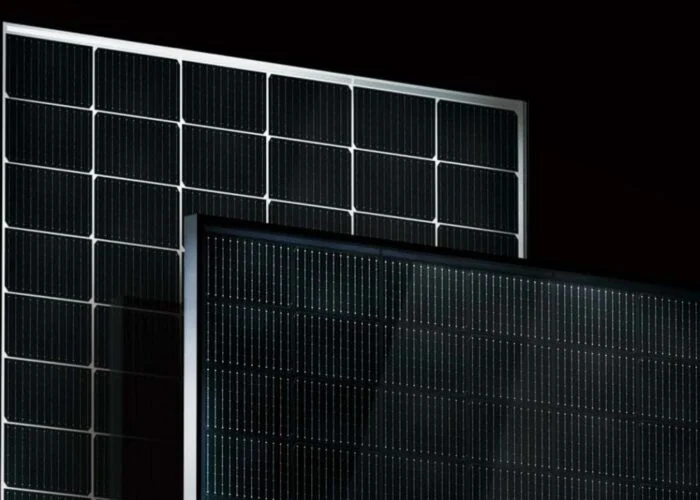
The company claims that its perovskite modules can be up to 30% more efficient than current market standard panels, offering “improved power-to-weight ratio, increased power density, enhanced radiation tolerance” and US-made technology.
Swift Solar has been backed with US$7 million in funding from the US Department of Energy (DOE) and a Series A funding round led by Italian energy major Eni and Stamford University.
Andre Slonopas, Cyber Fortress Lead with the US Army, said: “By strengthening operational energy resilience, US-made perovskite solar technology can directly address the growing power demands of the modern battlefield and enhance overall military readiness.”
Joel Jean, CEO of Swift Solar, said: “Partnering with the DoD at Cyber Fortress validates our US-made perovskite solar technology in real-world defence conditions and underscores Swift Solar’s potential as a key provider of ultra-efficient, next-generation solar solutions for the US government and beyond.”
Earlier this month, at the PV CellTech USA conference, our reporters found that perovskite technology was at the top of the agenda for US industry leaders, with the greatest excitement around two-terminal perovskite solutions. This followed an exclusive interview with Qcells’ CTO, Danielle Merfeld, who said that perovskite-based technologies could dominate the solar industry “within a decade”.
Experts have previously said that the rollout of perovskite tandem technology would begin with niche applications, like defence or space deployments, before taking off in the commercial & industrial (C&I), residential and utility-scale sectors.
Defence and space deployments benefit particularly from the greater power-to-weight and power-to-area ratio of perovskites, as a result of their increased efficiency. These deployments are also less sensitive to the greater cost-per-watt and lower stability of perovskite products than large commercial installations.
Stability remains the main barrier to the mass commercial deployment of perovskites. The material is very sensitive to air and moisture, which has hampered its development and entry into the market. Earlier this year, PV Tech Premium published a deep dive into the “hope and hype” of perovskite technology.