The European solar sector is at something of a crossroads, with many countries keen to expand their solar portfolios, but caught between the US to the west, and China to the east, as manufacturing superpowers that are dramatically increasing module production.
To an extent, the emergence of Europe as a buyer for many of these panels has been a positive development, with such imports critical to meeting the EU’s increasingly ambitious solar plans, with the body’s members targeting an increase in installed solar capacity of 90GW by the end of the decade.
Try Premium for just $1
- Full premium access for the first month at only $1
- Converts to an annual rate after 30 days unless cancelled
- Cancel anytime during the trial period
Premium Benefits
- Expert industry analysis and interviews
- Digital access to PV Tech Power journal
- Exclusive event discounts
Or get the full Premium subscription right away
Or continue reading this article for free
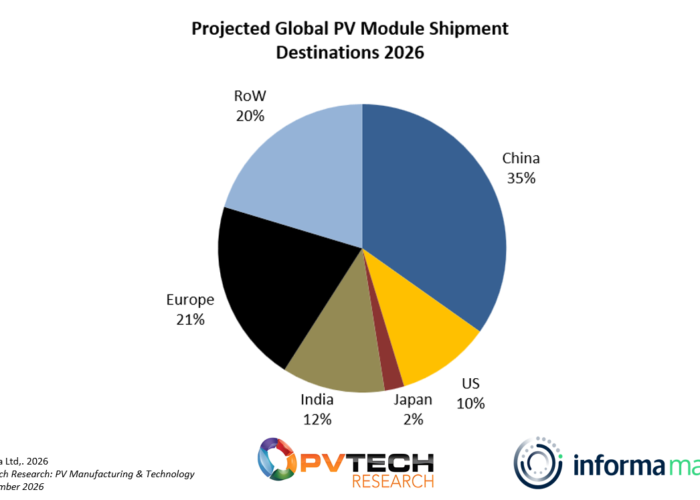
However, in recent months, there are simply too many modules in Europe to be effective, with more than 40GW of Chinese-made modules sitting unused in European warehouses this summer. This trend is supported by recent import data in the European solar sector. During a webinar last month, Solar Media head of research Finlay Colville and Seraphim’s vice president of global sales Insan Boy noted that, between 2021 and 2023, Europe’s annual module imports are likely to more than double from 40GW to around 100GW.
Ultimately, strong interest in new solar installations, but an inability to manufacture modules at the same prices as giants in the US and China, has left the European solar sector in a challenging position, one where the sector remains, to a large extent, at the mercy of international supply chains. PV Tech Premium spoke to Isabel Rodriguez, managing director at European renewables investment firm Glennmont Partners, about the challenges for the European solar supply chain.
What are some of the challenges affecting the European solar supply chain currently?
Isabel Rodriguez: In Europe engineering, procurement and construction (EPC) for solar has been heavily impacted by the supply chain risks and crisis that happened out of Covid-19. This was basically elongating the timelines and causing volatility on the price of components causing difficulties in fixing the price, which is the priority.
Within Europe full wrap EPC prices can vary also depending on labour cost; however supply chain considerations are global across Europe, and it has affected equally all EPC contractors. Naturally those EPC contractors that have a bigger backlog of orders of components, and have built the relationship with the supply chain in China, have an advantageous position to that effect.
Across southern Europe regulation was and continues to be keen on renewables however the development framework and process needs to be managed in a more efficient manner to solve the existing bottlenecks that are impacting both developers, sponsors and EPC contractors. From the early permits needed to start construction to the final operational permits from the grid operator.
How would you respond to the idea that delays in permitting are causing a significant bottleneck in the industry?
IR: The permitting process have suffered delays linked to the licencing progress; this has created in some countries a significant backlog of projects that now need to be built in a very constrained timeline in order to reach the final permitting milestone.
Renewable energy deployment needs a well-defined regulatory framework that is clear and fosters a timely construction and operation of the projects. It’s the linkage between the different government bodies, and the different permitting authorities for grid construction and operation.
How have priorities in the European supply chain changed in recent years?
IR: The supply chain has been an issue globally, because solar supply still remains [for the majority] in China. There have been some movements about creating some of the supply chain from Europe. If that happens, then we will see increased competition because the cost of producing this is not the same.
Also there is more and more focus on environmental, social and governance (ESG) considerations across all levels, and there’s going to be a stronger demand, from sponsors to the EPC contractors, to really respect this regulation and the ESG consideration for the supply chain, because there are still some question marks as to the origin of certain components.
That is very important to look at – and we do look at it quite carefully within our organisation for example – and it is a consideration from for some of the banks.
Do you think the European solar supply chain is functioning effectively?
IR: Obviously yes, we had a number of external events that have created a massive impact, but [renewables] are still quite resilient, There is constant evolution in terms of technology of cabling with other technologies to facilitate flexibility.
Our publisher Solar Media is hosting the 11th Solar Finance & Investment Europe conference, 31 January – 1 February at Park Plaza in London. Discussion topics will include renewable capital allocation, scaling European solar and maximising returns for solar-plus-storage projects, and Isabel Rodriguez will moderate a discussion on EPC bottlenecks in the solar sector. See the official site for more details.