India’s expanded production-linked incentive (PLI) scheme for solar manufacturing could be altered to encourage more domestic PV players to participate.
The INR195 billion (US$2.6 billion) programme is likely to be split into two or three tranches to include various companies, Indian newspaper The Economic Times reported, which quoted a government official as saying: “We can divide the PLI into different buckets for polysilicon to module making, wafers to modules and cells to modules manufacturing.”
Try Premium for just $1
- Full premium access for the first month at only $1
- Converts to an annual rate after 30 days unless cancelled
- Cancel anytime during the trial period
Premium Benefits
- Expert industry analysis and interviews
- Digital access to PV Tech Power journal
- Exclusive event discounts
Or get the full Premium subscription right away
Or continue reading this article for free
Initially intended to support 10GW of integrated solar PV manufacturing plants through an investment of INR45 billion, the first PLI tranche gave preference to companies that plan on setting up integrated PV manufacturing plants.
With nearly 55GW of bids submitted, the first PLI round was more than four times oversubscribed and closed with transformer manufacturer Shirdi Sai Electricals and Indian conglomerates Reliance Industries and Adani securing funding.
Funding for the programme has since been increased more than fourfold and is expected to support the creation of up to 40GW of additional cell and module manufacturing capacity, according to rating agency ICRA.
India’s Ministry of New & Renewable Energy did not respond to requests to comment on how the expanded PLI will be designed when approached by PV Tech.
Vinay Rustagi, managing director at consultancy Bridge to India, said that with the government still taking feedback from industry, the design is still not clear, adding: “But all indications are that preference would be given to companies with larger capacity, greater vertical integration and domestic value addition.”
PV Tech reported earlier this month that winners of funding in the initial round will be allowed to participate in the expanded tranche, but with their total bids capped at 10GW, inclusive of capacity awarded previously.
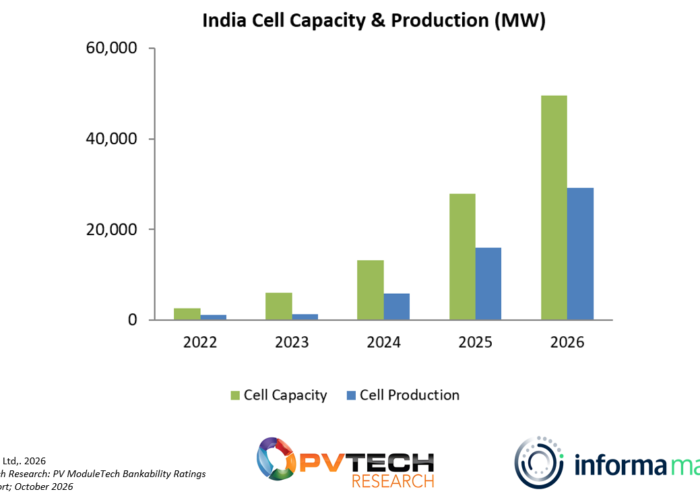
While India currently has 18GW of module and 4.3GW of cell manufacturing capacity, actual production is significantly lower as most facilities operate at a capacity utilisation factor of less than 50%, according to a report published last month by consultancy JMK Research & Analytics and thinktank the Institute for Energy Economics and Financial Analysis.
They said one of the reasons for the gap between cell and module capacities is a lack of vertical integration of domestic solar production plants.
JMK forecasts that India will double its module manufacturing capacity to 36GW in the next two years, thanks in part to the PLI scheme.