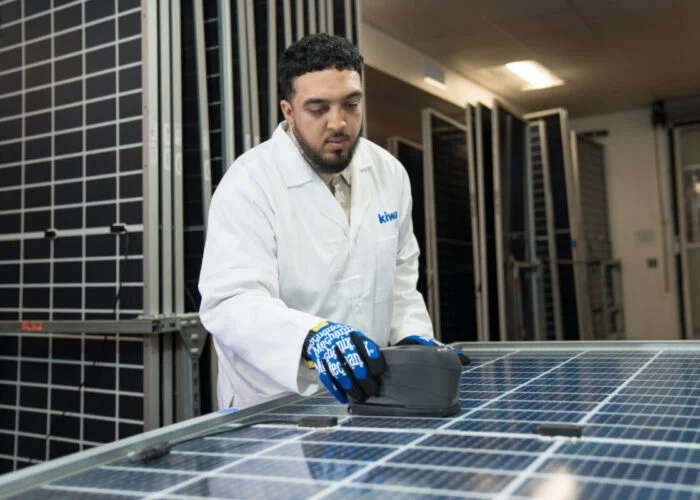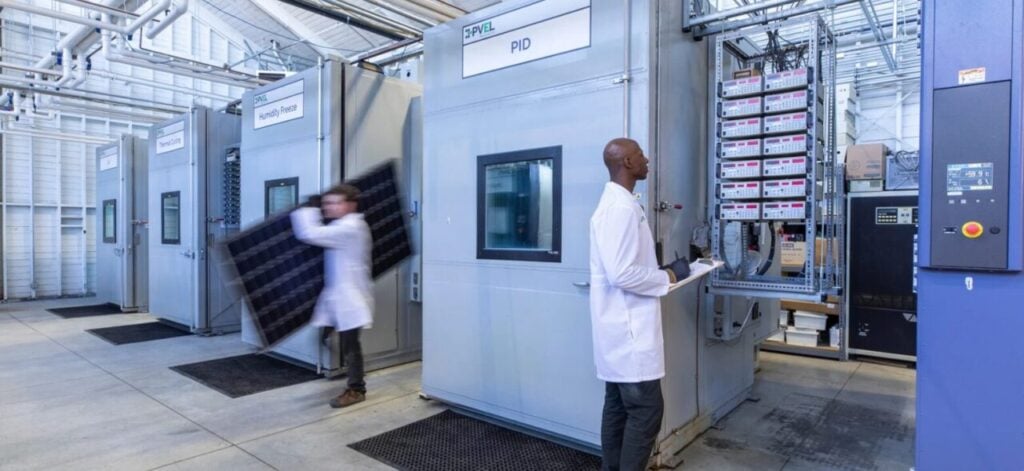
Testing and quality assurance provider Kiwa PVEL has updated its solar module Production Qualification Program (PQP) to better assess modules’ performance on spontaneous glass breakage, frame structural failures and hail damage.
A key part of the change is the addition of “test-to-failure” (TTF) protocols for both static mechanical load testing and hail testing, which will aim to find the maximum possible load a module can withstand in both environments. The static mechanical load testing will complement Kiwa PVEL’s existing mechanical stress sequences, while the new hail testing replaces the old hail stress sequence programme, and will now see five modules tested per round of testing, with emphasis on areas that are most prone to breakage, such as edges, corners and junction box regions.
Try Premium for just $1
- Full premium access for the first month at only $1
- Converts to an annual rate after 30 days unless cancelled
- Cancel anytime during the trial period
Premium Benefits
- Expert industry analysis and interviews
- Digital access to PV Tech Power journal
- Exclusive event discounts
Or get the full Premium subscription right away
Or continue reading this article for free
The testing house also plans to perform a number of new tests, including full-spectrum light soaking and damp heat testing, particularly for the benefit of n-type technologies that have become “dominant” in the global solar industry, according to Kiwa PVEL. The company also announced a number of refinements to its other testing processes based on industry trends, such as reducing the sample size for light-induced degradation (LID) testing from 17 to ten modules, due to “low and consistent LID values” in recent years.
The changes to the testing process come as record numbers of modules have reported failing grades in Kiwa PVEL’s flagship Module Reliability Scorecard. A total of 83% of module manufacturers had at least one test failure in the 2025 scorecard, up from 66% in 2024, demonstrating the importance of continually assessing and upgrading the testing process.
“Regularly iterating on the PQP makes it the most relevant test plan for today’s module technologies and failure modes,” said Kiwa PVEL managing director Kevin Gibson. “These updates allow module manufacturers to better showcase product reliability and performance on their current offerings.”
Kiwa PVEL has suggested that many of the struggles faced by modern modules stem from the fact that they are being built larger and thinner than before, making them more vulnerable to physical damage.
“As manufacturers have pushed toward larger modules and thinner materials, these sudden breakage events have made it clear that more rigorous and statistically meaningful testing is needed,” explained Tristan Erion-Lorico, vice-president of sales and marketing at Kiwa PVEL, who was one the authors of a guest blog on PV Tech last year that explored this phenomenon in greater detail.
Erion-Lorico was one of the authors of a separate guest blog for PV Tech last month, which found that module breakage “dominated” discussions at the 2026 Photovoltaic Reliability Workshop (PVRW), as these thinner modules have struggled to stand up to the rigours of real-world operation.
Kiwa PVEL’s particular emphasis on hail, too, is notable as hail damage has become one of the most significant threats to both the operation of a solar project’s modules, and the profitability of that project as a whole. Last year, figures from kWh Analytics found that hail incidents accounted for 73% of financial losses for US solar PV projects, despite accounting for just 6% of the total number of loss incidents, demonstrating the disproportionate financial impact hail can have on a solar project.