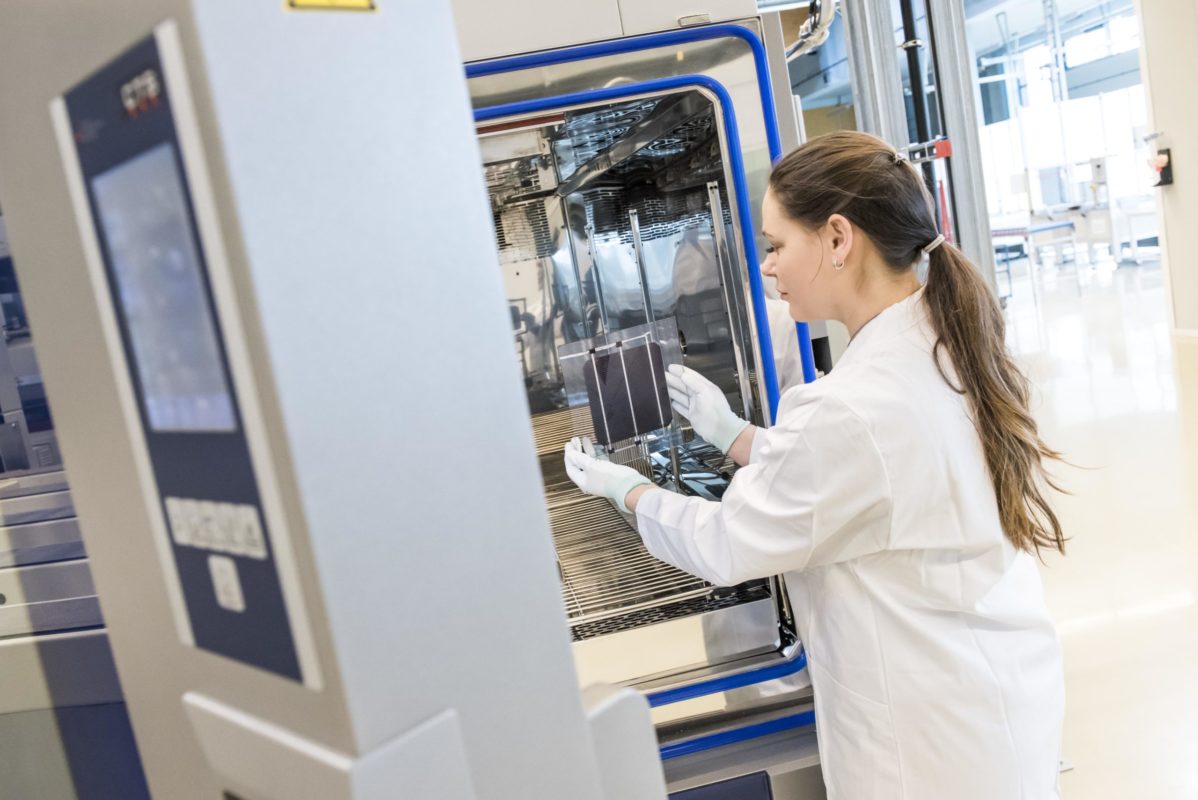
Perovskite solar cell developer Oxford Photovoltaics (PV) has produced a 1 cm2 perovskite-silicon two-terminal tandem solar cell with a verified conversion efficiency of 25.2%, through an ongoing collaboration with Helmholtz-Zentrum Berlin (HZB) and the Photovoltaics and Optoelectronics Device Group at the University of Oxford, led by Professor Snaith.
The two-terminal tandem solar cell efficiency was certified by the Fraunhofer Institute for Solar Energy Systems ISE and the results were presented this week at the WCPEC conference held in Waikoloa, Hawaii.
Try Premium for just $1
- Full premium access for the first month at only $1
- Converts to an annual rate after 30 days unless cancelled
- Cancel anytime during the trial period
Premium Benefits
- Expert industry analysis and interviews
- Digital access to PV Tech Power journal
- Exclusive event discounts
Or get the full Premium subscription right away
Or continue reading this article for free
Dr Chris Case, Chief Technology Officer at Oxford PV commented, “The unique, optically enhanced architecture developed as part of this collaboration, minimises losses, and has helped us achieve this record setting efficiency.”
“With our combined progress in efficiency, stability and reliability, our perovskite-silicon tandem solar cell technology is now reaching its commercial potential. As with any new technology, the biggest challenge is transferring the technology from the lab and scaling up to high volume manufacturing. The company has already made great progress in this respect and our industrial pilot line is producing commercial sized 156 mm x 156 mm perovskite-silicon tandem solar cells for validation by our development partner – a major manufacturer of silicon solar cells and modules.”
The two-terminal design is intended to simplify the integration into PV module fabrication, compared to four terminal architectures often used in scientific research, eliminating additional materials, weight and power invertor challenges found in four-terminal tandem cells.