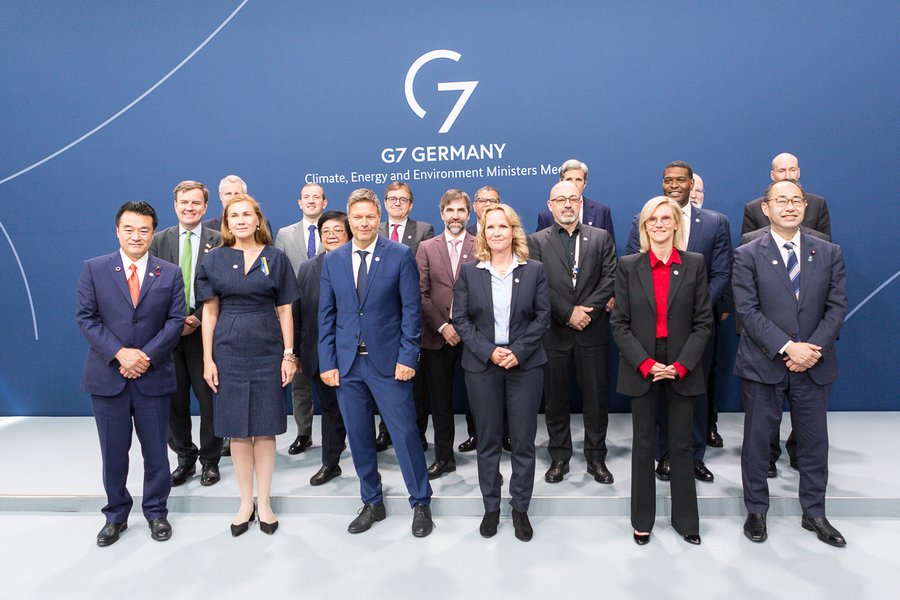
The G7 have agreed not to fund any overseas fossil fuel projects by the end of this year at a meeting in Berlin, Germany in which they also doubled down on their commitments to a faster energy transition in light of Russia’s invasion of Ukraine.
The group – made up of the UK, the US, Canada, Italy, France, Japan and Germany – said that all public financing for overseas fossil fuel projects would be stopped, something it was planning to do at COP26 in Glasgow last November had the pledge not been blocked by Japan.
Try Premium for just $1
- Full premium access for the first month at only $1
- Converts to an annual rate after 30 days unless cancelled
- Cancel anytime during the trial period
Premium Benefits
- Expert industry analysis and interviews
- Digital access to PV Tech Power journal
- Exclusive event discounts
Or get the full Premium subscription right away
Or continue reading this article for free
Environment ministers representing the countries also again committed to phasing out emissions from their energy sectors by 2035 (or earlier in some cases) as they eyed a faster roll out of renewables.
US climate envoy John Kerry said the “forward-leaning” commitment by the G7 to decarbonise their grids would pressure the wider G20 group, which is responsible for 80% of global emissions, to do the same when they meet later this year.
“We will drastically increase electricity generated by renewable energies, as well as the use of renewables in heating, cooling and transportation,” G7 ministers said in a joint communique, which referenced the International Energy Agency’s (IEA) 10-point plan to cut the EU’s reliance on Russia imports.
“To achieve our goals, we will remove barriers and obstacles that currently hinder or slow down the expansion of renewable energies, for example in the context of planning and permitting procedures, market design, grid operation, fiscal incentives and investments in infrastructure needed for the integration of high shares of variable renewables,” they said.
The speeding up of permitting and planning processes has formed a key part of the EU’s new REPowerEU strategy aimed at reducing the bloc’s reliance on Russian fossil fuels imports and which promises to change Europe’s energy apparatus forever, although the plan is at risk from high material and module costs.
Kadri Simson, the European Commissioner for energy, tweeted: “The G7 climate, energy & environment ministers agreed in Berlin that to increase our energy security, we need to accelerate the green transition by using innovative, clean, safe, reliable & sustainable energy technologies. Energy efficiency & renewables will play a major role.”
Meanwhile, the G7 called on OPEC to produce more crude oil in response to the current energy crisis, which has seen massive inflationary pressure within the industrialised, consumer countries of the G7 and elsewhere.
“We call on oil and gas producing countries to act in a responsible manner and to respond to tightening international markets, noting that OPEC has a key role to play,” read the communique.